
Jul 24, 2026
[alert type=”warning”]The following is an exclusive feature that has been shared with you but is otherwise available only in Issue #4 of the Christ and Pop Culture Magazine. For more features like this, download our app for iPad and iPhone from Apple’s App Store. After a one-week free trial, monthly and yearly subscriptions are available for $2.99 and $29.99 respectively. New issues are made available every other week. More information here.[/alert]
By Scott Garbacz
Download the entire issue here!
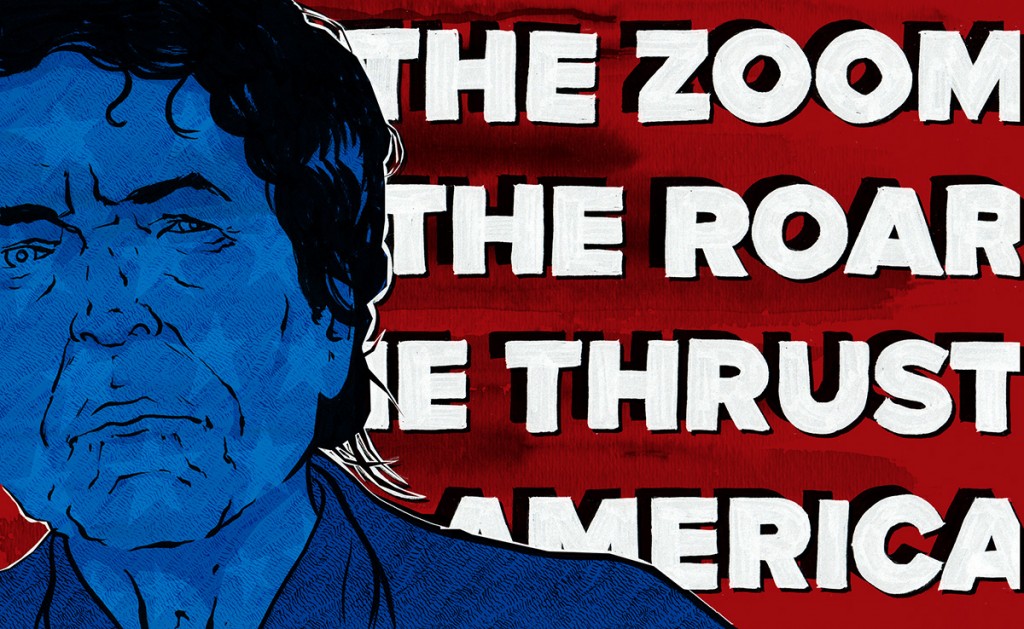
“What,” asks Bob Dylan in Chrysler’s recent Super Bowl advertisement, “is more American than America?”
Coming from anyone else, such a redundant question would have already sent me to sleep. Coming from Dylan, and juxtaposed with black-and-white film of young Dylan facing an adoring crowd, it is rather striking. Bob Dylan, it implies, might be the one thing more American than America—because like the spot’s black-and-white footage, and like the images of Marilyn Monroe and James Dean that later flash on the screen, Dylan embodies the dream of expressing one’s inner being with such authenticity that one becomes an icon of individuality, independence, and “cool.”
http://www.youtube.com/watch?v=KlSn8Isv-3M
There is an irony, of course, in authenticity being used to sell cars. This is particularly true when the artist in question has vowed to “walk to the depths of the deepest dark forest / where the people are many and their hands are all empty … where hunger is ugly, where souls are forgotten … And I’ll tell it and speak it and think it and breathe it.” The current incarnation of Dylan is quite a bit different from the young Dylan who sang passionately as a counter-cultural folk artist and activist. But then again, who is to say that this car-selling Dylan, or the Dylan of 2004’s Victoria’s Secret advertisement, isn’t just as authentic as the Dylan who wrote “Masters of War” or “Subterranean Homesick Blues” in the 1960s?
“The heart is deceptive above all things,” as Jeremiah 17:9 has it, and Dylan’s drive to be true to his own heart has lead to a life of abandoning his public stances. People screamed “Judas!” when the acoustic folk-singer picked up an electric guitar; Civil Rights leaders were shocked when he walked away from the movement he’d so fiercely championed; Evangelicals celebrated his conversion to Christianity, only to see him quietly stop talking about his own religious convictions.
 In one sense, Dylan’s aversion to labels may be laudable. In today’s culture, it is refreshing to see a celebrity who runs away from his worshippers whenever they attempt to deify him. But in another sense, and I say this as someone with an immense respect for Dylan’s artistic accomplishments, his own persona is hollow in comparison. Each incarnation of Dylan’s music has a new cause to triumph, but the man himself ultimately appears driftless, banal, unwilling to dedicate his life to anything in particular. If the heart is deceptive above all things, maybe it’s better that we don’t simply (Dylan-like) seek to represent ourselves authentically, but instead strive for something more.
The Coca-Cola’s advertisement, “It’s Beautiful,” offers one attractive vision of what “something more” than authentic expression might look like. In sixty seconds, men and women dressed to represent a number of different cultures and careers sing “America the Beautiful” in eight different languages. The film’s blatant (yet, sadly, controversial) celebration of the geographic, cultural, linguistic, and religious diversity of America offers a richer vision for self-expression than narratives of pure “authenticity.” Identity, the ad implies, is an act of participation in a whole greater than oneself. The spot’s singers retain their culture’s distinctive voices, dress, and language, but they are also (quite literally) given a new song to sing. While these speakers presumably identify with fellow speakers of English, Spanish, Tagalog, Mandarin, Hindi, Hebrew, Keres, French or Arabic, their identity is changed by their participation in the great American experiment. They are now, in short, Americans. Like CaPC’s Tyler Glodjo, the thing I found most compelling about the commercial is the image of “every tribe, tongue, and nation” coming together in a single act of glorious praise, where diverse voices and talents can harmonize beautifully.
 As a Christian I am very skeptical of those who want me to look to America for my primary source of identity. America, unlike Dylan, often tries to deify itself, demanding that Christians worship America as uniquely virtuous among nations. Moreover, when we think of our “authentic” selves as being Americans first rather than Christians, we are tempted to approve of national actions that we ought, as Christians, to condemn. Yet I still feel that the “It’s Beautiful” advertisement offers a healthier, more nuanced view of identity than the go-against-society “authenticity” of Dylan and Chevrolet. Singing the same song in different languages, people neither discard their own distinctives nor throw away their participation in the collective good. Just as in Revelations 2:9 “Every tribe, tongue and nation” worships Christ using their own languages and customs, and just as in Genesis 1:27 God creates humanity both “male and female” to better reflect God’s vision for diversity, the song speaks to a glorious whole in which people are both uniquely themselves and part of a project whose grand (if vague) aspirations go far beyond authenticity.
The pursuit of authenticity often amounts to a pursuit of ourselves, rather than the pursuit of something better than ourselves. Moreover, since our hearts are always lying to us, and since our hearts are always in a constant state of change (for better and for worse), the pursuit of authenticity can be a fool’s game. Our striving for authenticity can be like a horse reaching for a carrot held in front of its nose–an ultimately futile activity that drives us forward while simultaneously blinding us to where we are actually going. If we instead understand our identity to be complex, tied in to the communities, stories, and causes to which we are committed and not just to our inner being, we can begin to look at where we are headed in the world, and not just obsess about the old question of who we “really are.”
 Of course, many aspects of “authenticity” are quite good and praiseworthy. Certainly it is right to condemn easy hypocrisy–that is, to condemn people who try to claim the benefits of public identification with a cause they don’t actually labor to support. Certainly it is worthwhile to seek a sort of integrity in one’s own life, beliefs, and actions, so that you aren’t (for instance) preaching about loving the poor while refusing to get involved yourself. A wise man once told me how his father, hearing his childlike prayer that God bless “the widows and orphans,” lovingly poked a hole in his inflated self-perception. After a particularly ornate prayer, the father told his son to grab his tool-belt, so that he could actually help those widows and orphans he claimed to care so much about. In a society teeming with fake religion and easy feel-good experiences, it is helpful to remind ourselves that we ought to seek as Christians an authentic religious life, the “pure and undefiled religion” of James 1:27 that requires difficult charity and painful self-denial.
Yet at the end of the day, the important question is not “who are you, really?” (as if you could ever understand such depths). The important question is “what story are you in, and what place can you take in that story?” The greatest story I know is the story of God’s work of redemption, where we are required both to “die to ourselves” and to exercise our unique gifts within the body of Christ. Let the Bob Dylans of the world have their carefully regulated self-expression, their ability to defy every expectation in order to remain true to the ever-changing contours of their own desires. We, as Christians, have something quite a bit better: a vision of individuality and collectivity that makes all other discussions of authenticity fail in comparison, and the promise of a genuine relationship with God in which we will be slowly transformed into people quite different from what we are now–but people that are, at the same time, the creatures we were always meant to be.
Download the entire issue here!
As a professor of English, a semi-professional nerd, and one professing faith in Jesus Christ, Scott Garbacz can never be satisfied with this world. As a husband, father, and teacher, he is still tempted to do so. He currently works and studies for the University of Texas at Austin.
Illustration courtesy of Seth T. Hahne. Check out Seth’s graphic novel and comic review site, Good Ok Bad.