
Jul 24, 2026
When the box arrived on my doorstep, I didn’t think much about it. I’ve become accustomed to random packages appearing there. My husband pastors a rural church in Virginia and often has tracts, bulletin covers, and baptismal certificates shipped to our house rather than risk them being dropped at a side entrance of the church only to go unnoticed until after a rainstorm. But this package was different. It was nearly three-and-half feet long and six inches square. On closer inspection, I realized that it wasn’t for the church at all; the return label read
David C. Vernon,
Century Farm Orchards,
Reidsville, N.C.
In many ways, this too was no surprise. Besides being a pastor, my husband is an avid gardener; nothing excites him like the arrival of seed catalogues and the potential bound up in a plant. So when he returned from work, he immediately noticed the box reclining against the kitchen wall where I’d unceremoniously dumped it. “Oh, they’re finally here,” he said, making no attempt to hide his enthusiasm. He quickly cut open the box, reached inside, and drew out what I could only assume were a bundle of dead sticks. There were five in all, each about 3 feet long, thin as a slip, and bare-rooted. He then proceeded to tell me that he had just paid $25 apiece for them.
An Apple a Day
The “sticks” that my husband had ordered were actually apple trees. Heirloom apple trees to be exact. We had bought our first home only a few months prior, and it sits on a half-acre of nearly flat, treeless land, ripe for cultivation. My husband’s plans for it included a vegetable garden, berry bushes, chickens, and a host of fruit and nut-bearing trees. These heirloom apples were the first step toward that dream.
In many ways, the story of these apple trees is also the story of the aggregation of America’s food supply. As food production moved away from back yards and family farms to large scale industrial enterprises, particular types of apples were selected for their disease resistance and storage life. But while this raised corporate efficiency, it lowered the diversity that was available. In the mid-1800s, there were thousands of unique varieties of apples, but walk into a typical grocery store today, and you’ll find no more than a handful—common ones include Yellow and Red Delicious, McIntosh, Gala, Fuji, and Granny Smith.
But it’s not simply a question of availability. As older trees die off and family farms morph into subdivisions, the varieties our grandparents knew—like Johnson Keeper, Esopus Spitzenburg (reportedly Thomas Jefferson’s favorite apple), Mary Reid, Yellow June, and William’s Favorite—head toward extinction. Smaller orchards, like the one where my husband purchased his trees, have committed to preserving and propagating what would otherwise be lost. For my husband, the choice to plant heirloom varieties instead of more mainstream ones was pretty straightforward.
Back to the Land
What is not as straightforward is the larger conversation that surrounds these apples.
The terms “heirloom” and “heritage” (applied to livestock) usually come packaged with another set of terms: “local,” “organic,” “natural,” “free-range,” and “grass-fed.” These are the linguistic demarcations of a “back-to-the-land” movement that promotes simple living and sustainable sources of food, ideally farmed without the use of antibiotics or chemical pesticides, herbicides, or fungicides. What began as a reaction to industrial agriculture is today a $35 billion dollar a year industry. It is also a growing part of Millennial social consciousness and family life.
On a personal level, I owe a lot to the back-to-the-land movement. Back in the 1970s, my parents found that its core values, which include a rejection of material wealth, a counter-cultural posture, and strong work ethic, merged nicely with their Christianity and rural Appalachian roots.
Consequently, I grew up on a 10-acre homestead in Pennsylvania, and the first house I remember was the one my dad built from logs harvested from our property.
But when I went off to college, I began to realize that these ideals were something of an anomaly. Surprisingly, the ability to forage for berries, preserve garden vegetables, and care for chickens were not widely regarded as part of a marketable skill set. Thrown into a definitely suburban context, I made friends but often felt alone and an outsider. Until I met my husband. He had been raised in a similar agrarian context in Virginia, and our relationship flourished around the shared rhythms of simple living, idealism, and family.
Where Moth and Rust Doth Corrupt
The day after my husband’s apple trees arrived, he dug five holes along the border of our property and filled them with a mixture of soil, bone meal, and lime. He then took his “$25 sticks” (as I had come to think of them) and planted one in each hole. My dad had suggested encasing the saplings in corrugated black plastic drainage pipe to protect them from deer and other pests.
For the next several months, throughout the fall and winter, the trees lay dormant. When I looked out my bedroom window, all I could see were five sections of black plastic pipe standing at attention, neatly aligned in a row where trees would one day be laden with heirloom fruit (or so my husband promised.) But we were doing our part; we were preserving the heritage we had been given.
Soon enough, winter thawed and spring came. Those sticks began to bud and eventually sported small, velvety leaves. But with these signs of life came pests and disease. Each morning, my husband would wake up, shower and eat breakfast, and then walk out to check his trees. Quite regularly, he would find that they had been nibbled by deer that crossed our property during the night. Those trees heard words that my children should not. To combat the deer, he applied Liquid Fence, an ecologically-safe animal repellent. It smelled terrible and worked. But as soon as the deer were under control, the trees were struck by a fungus. That spring was particularly wet, and the young leaves were soon covered in Gymnosporangium juniperi-virginianae, known around here simply as “rust.” And then once the trees put out their light pink blossoms, the insects swarmed, welcoming the invitation to feast on them.
Optimism turned to frustration and my husband faced a very real dilemma. In order to preserve these heirloom apple varieties for future generations, he needed to take measures not available to our great-grandparents. He soon found himself in the pesticide aisle of Lowe’s.
Principled Pragmatism
For some in the sustainable food community, this act alone constitutes a compromise of principle. One of the core assumptions of the back-to-the-land movement is the superiority of natural solutions and a resistance to agricultural conventions like antibiotics and chemical pesticides. (Christians who are part of this return to agrarian living, sometimes replace the language of “nature” with “God” and view their efforts as returning to “the way God intended it to be.”)
The only problem is that nature—gardens and bodies included—does not work the way God intended it to work. And it hasn’t for quite some time. Eden is no longer the “natural” state of creation. What is natural is a world groaning under a curse of pestilence and disease. In many ways, my husband’s dilemma about how to best protect his apple trees wasn’t simply a choice between organic or chemical methods. It was a dilemma about how to navigate a broken world. How do you balance principle with reality? Is it legitimate to make minor compromises to achieve ultimate goals? What once was clear in the light of day was not so clear when clouds block the sun; and learning to navigate in the shadows requires more than idealism. It requires wisdom.
Wisdom involves not only understanding how things should be but how they are. In many ways, wisdom is a “principled pragmatism” –the ability to see all the dimensions of a situation and make the best decision possible with the given limitations of that situation. But for many Christians, pragmatism is very nearly a four-letter word. After all, the end does not justify the means, it’s the principle of the thing, and a little leaven leavens the whole lump. But in its most basic form, pragmatism does not mean overlooking the brokenness of world; it simply means taking it into account.
Surprisingly the Scripture actually encourages certain forms of pragmatism. The book of Proverbs warns against taking bribes, but it also advises that giving a gift often smoothes the way. A judge should not be unjust, but because they often are, the persistent plea of the widow can be effective. In modern parlance, “The squeaky wheel gets the grease.”
What Scripture seems to object to is unprincipled pragmatism. While principled pragmatism factors in the brokenness of this world, unprincipled pragmatism factors out the reality of redemption. Unprincipled pragmatism says “Eat, drink, and be merry for tomorrow we die.” In other words, get while the getting is good, no matter how you have to do it. In this sense, unprincipled pragmatism is worldliness run amuck. Because while many associate worldliness with specific categories of behavior, worldliness is simply the belief that material realities are all that matter. This cosmos, this world, this system, this time is the ultimate reality. And precisely because worldliness does not look to the future, it also does not weigh the consequence of an action.
In many ways, the back-to-the-land movement is a valid response to the unprincipled pragmatism—to the worldliness—of industrial agriculture. Watch a documentary like Food Inc. that explores the inhumane treatment of animals and you’ll question whether or not that chicken on your plate was free-range too. Or realize that you’re eating the same kind of apple over and over again, and you might plant a few heirloom varieties in your own backyard. But once you do, you shouldn’t be surprised if you also find yourself spraying them with pesticide.
Walk Humbly with God
In “What Are People For?” Wendell Berry recounts a time when he built a pond on a piece of pasture land that was not sufficiently irrigated. He did his best to protect the land through the process, but after a wet fall and winter, the ground gave way and the pond ruptured, leaving deep damage to the landscape. Berry writes,
I was careful to get expert advice… but no expert knows everything about every place, not even everything about any place… In general, I have used my farm carefully. It could be said, I think, that I have improved it more than I have damaged it. My aim is to go against history and to repair the damage of other people. But now a part of its damage is my own.
There’s a humility that must undergird our stewardship of the earth, whether we are building ponds, cultivating heirloom apples, or deciding to buy organic, free-range chicken. We must recognize the limitations of our context and even our own brokenness. None of us has the capacity to be perfectly principled in all our decisions. Like Berry, my husband could have undoubtedly done more research; he could have experimented more; but even then, he would still have had to face the limitations of time and space. In pursuit of the “ideal,” he would have neglected other equally significant, equally necessary responsibilities.
And yet, if we have offended the law at any point—even the law of natural, organic living—we have offended all.
This spring, our $25 sticks stand several feet taller and are full of lush green leaves. The trunks are still encased in black plastic pipe to protect them from the bucks that would rub their antlers against them and strip them bare. And no doubt, the fungus they contracted that first spring will present itself again soon enough. But they are blossoming and my husband’s hopeful that we might just harvest a handful of apples by the end of the summer. Apples that by his calculations will have cost us $20 a piece.
Hannah Anderson lives in the Blue Ridge Mountains of Virginia with her husband and three young children. She is the author of Made for More: An Invitation to Live in God’s Image and blogs at sometimesalight.com.
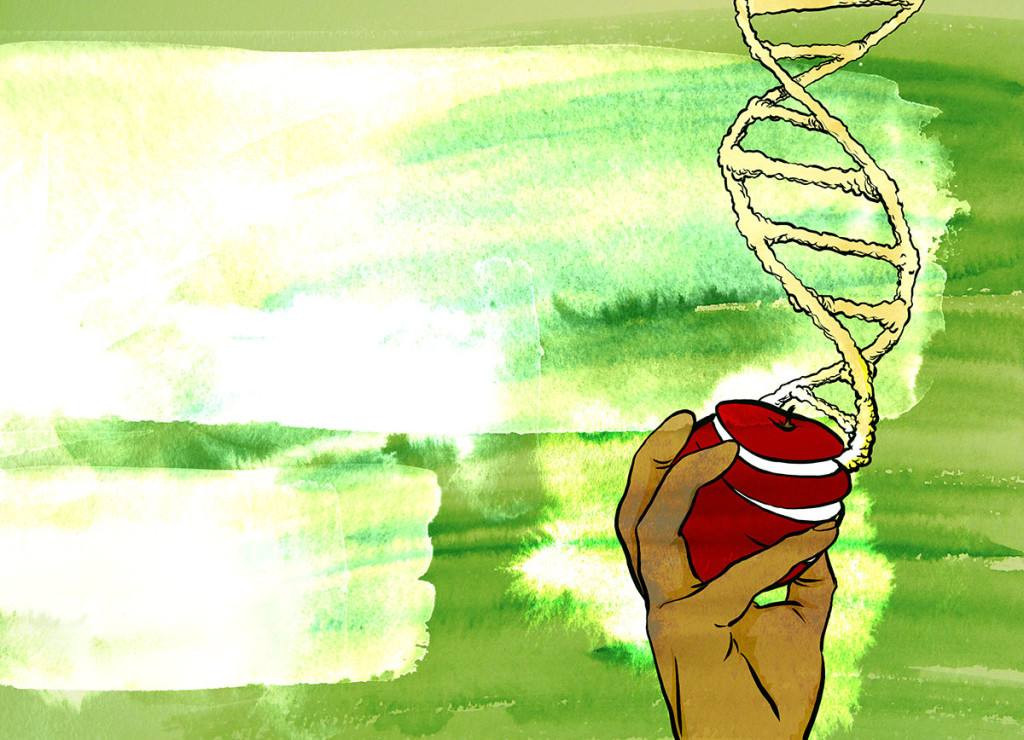
Illustration courtesy of Seth T. Hahne. Check out Seth’s graphic novel and comic review site, Good Ok Bad.