
Jul 24, 2026
By S.D. Kelly
In rural Ohio, where I grew up, agriculture dominated everything. The County Fair was the biggest event of the year. Kids belonged to multiple 4-H clubs with projects that involved everything from raising chickens to beef cattle to rabbits. Farming was a way of life and growing crops was always the topic of conversation, whether it was a matter of conquering tomato blight in the garden or weeds in the soybean field. When it came to cooking, to seeing the result of all this labor on the table, taste mattered, but pragmatism mattered more. The women I knew who cooked for church potlucks and family reunions swapped recipes based on the cost of ingredients, how much the recipe yielded, and how tasty the end product was — in no particular order.
I moved away from rural Ohio just after I married. Before my wedding, I mentioned to an older married woman that I would like to cook something other than casseroles. “No,” I was told in no uncertain terms. I was only ambitious because I was young and stupid. Once family life kicked in, it would be all casseroles, all the time. It seems that after a husband comes into the picture, not to mention kids, shopping for food is an exercise in stuffing the grocery cart with bags of noodles, cans of cream of mushroom soup and slabs of Velveeta cheese before heading home to throw it all into a casserole dish in exhaustion. Any good Midwesterner knows this. Pretending otherwise is to deny myself my heritage.
But what was my heritage when it came to food? I always assumed I understood my birthright, surrounded as I was by farmers and fields — people growing food on their land. My family even lived on a farm, the same farm my grandfather had lived on with his grandparents, though we had long since leased the fields to a neighboring farmer. Just like every other kid, I belonged to several 4-H Clubs, the County Fair was the highlight of my year, my brothers and boyfriend spent their summers haying, and we canned green beans and made pickles.
But then I realized: when it came to the food we rural people ate, whether at each other’s homes or in a restaurant, we didn’t much care where it came from. In fact, the further removed the source of food was from our agricultural county, the more we seemed to value it. A McDonalds came into our town and we rejoiced, because we were finally just like everyone else. A succession of chain restaurants followed, dotting the rural landscape like oversized cows. Mom-and-pop restaurants still existed of course, but only in villages too small to attract a Burger King or Ponderosa or Denny’s.
Through high school and college I worked at a couple of those mom-and-pop places. And while there may not have been the customer base to attract the attention of the big chains on the retail end, when it came to the supply side, distributors were perfectly happy to do business with restaurants located in nowheresville. The giant food distributor SYSCO sent a truck twice a week to the restaurant where I worked, the semi slowly backing into place on the narrow road in an effort to avoid crushing one of the pickup trucks parked in front.
The arrival of the SYSCO truck seemed like a sort of miracle to my eyes as it materialized from someplace far, far away, dispensing all sorts of frozen edibles out of its depths: pizza dough pre-shaped into small, medium and large round disks, bags of french fries already cut and seasoned, round patties of hamburger, oblong strips of mozzarella covered in breading and ready for the deep-fryer. All of it for our convenience. The restaurant’s cook sat in the back and brooded, and as the sole waitress I would pass an order to him through the window that opened onto the kitchen with great trepidation. He would snatch the order from the window and jam his kitchen knife into the cutting board in rage, cursing while he headed to the freezer to remove a frozen pizza-dough disk and a bag of shredded cheese.
When food is purchased this way, arriving frozen from Somewhere Else, it is easy to forget how food actually becomes food. It becomes nothing more than an end product; eating one thing is more or less the same as eating another, only with different packaging. Cooking is a matter of access, of opening a bag or a can or a box. When food comes already assembled, who can really tell what is in it, or more precisely, what it is? Are french fries made of potatoes? Probably. Can a birthday cake be made without a cake mix? Not likely. Is pizza dough made up of flour, salt, yeast and water? I can’t be sure. Is cheese really just cooked and fermented milk? I hope not! But, more to the point, who cares? As long as I can open a can or a bag, I can open a restaurant. All I need is a good knife or a pair of scissors, a can opener and access to SYSCO’s online ordering system. Somewhere along the way over the last several decades, food became truly democratic in America. Or, at least, cooking did.
In rural Ohio these days, where I no longer live but often return to my family’s farm, things seem to be running along smoothly. Gardens are still abundant, there 4-H Clubs aplenty, Farmers are still farming, discussing crop yields and experiencing combine and acreage-envy, the same as ever, except for the fact that they don’t grow food anymore.
Almost without any of us realizing it, Ohio farmers changed their crops. Every year farmers dutifully sow and reap corn and soybeans, following market prices with as much avidity as ever, clambering out of their climate-controlled tractors at the end of the day before heading inside the house for a plate full of sweet corn, corn that has likely been plucked from a field in Mexico before being trucked to the chain store supermarket just up the road from the farm. But the farmer’s own crop is inedible. The corn and soybeans he grows are taken to the grain elevator before being whisked away and turned into something else altogether, something that becomes an element of food (or not): corn syrup, fatty acids, and animal feed.
Maybe it doesn’t matter that the average Midwestern farmer no longer grows food. It’s hard to say that it matters if the people living in rural America, the people identified primarily with agriculture for generations, don’t seem to mind. Throughout my childhood, spent as it was in an old farmhouse surrounded by fields, I considered the American Farmer with a sort of reverence. In my mind’s eye, my farmer neighbor wandered through his fields at dusk after a long hard day, pulling back the husk from an ear of corn with his calloused hand which was marked by soil and sweat to test a few kernels. He chewed them slowly to see how the corn was coming along. As an adult I’ve had to consider a different reality: raw field corn is not fit for human consumption and nobody is wandering through a cornfield at dusk, because now the corn is very tall, unnaturally tall, and a person could get lost.
I’m sure I’m not alone in wanting to retain the ideal of the farmer who made, because it seemed as though he had no choice, the work of his entire life into a sort of a prayer, entirely reliant on the God who controls the world and its weather to make things go his way. Back in the days of pre-industrialized farming, we all felt, along with the farmer, more dependent on God. We needed the farmer to act supplicant, petitioning God for a strong wheat yield so that we, in turn, could grind it into flour for our daily bread. Year after year the prospect of crop failure with implied financial ruin — or worse — loomed, and the need for God did not alter, in season and out of season.
But now, things are different. The culture of the field has changed in much the same way as the larger culture has changed. The reality is, while the image of the supplicant farmer may be iconic, it is no longer accurate. The American farmer has gone the way of the 19th-century cowboy and the the frontiersman before him. Modern farmers have traded the subsistence farming — the specter of poverty and failure that comes from growing food in unstable weather and market conditions — for growing lab-tested food products, subsidized by the government and her giant corporate friends, trading food for food products that yield with a reliability and bounty that defies nature.
I know the farmers living in my home county have made this trade-off, and I don’t blame them. I can’t even handle the difficulties of contending with bugs eating the kale I’m growing in two measly rows in my garden; I can’t imagine taking on responsibility for growing anything more. But in this trade-off, there is a sense of loss. The question is whether this sense of loss is just misplaced nostalgia for rural America or whether the American farmer has indeed given up something irreplaceable in this new era of industrial farming. Maybe farmers have to make a choice, a choice defined by the economies of scale, between the small family farm with its storied reliance on God and the miracle of seed germination and the large industrial farm with its reliance on government subsidies, crop insurance, and the science of hybrid seeds.
Where I’m from, food is still cheap: the mozzarella sticks and frozen pizzas and sweet corn from Mexico are still plentiful, but speaking as an Ohioan, it sometimes feels as though we are no longer quite as sure what it means to be a rural American. The tables at church potlucks are loaded with the same sort of food as before, only now it comes from fast-food restaurants, from mixes and cans and bottles. Buckets of KFC and salads made from packages of ramen noodles are the order of the day. But, I tell myself, at least these potlucks still take place. Compared to many Americans living in more populous areas, rural Americans are still going to church and still sitting down together afterward to break bread–bread which comes from a far-away factory, maybe, but bread all the same.
So, in that sense, maybe what I perceive as a choice between pre- and post-industrialized farming and the correlating dependence on God is not really a choice at all. We are always, no matter the means of delivery, dependent on God for his provision, whether through the miracle of seed science or the miracle of the loaves and fishes. In any place, in any time, in the field or out of it, we pray as Jesus taught us to pray: our Father, who art in heaven . . . give us this day our daily bread.
S.D. Kelly lives with her family in coastal New England, where she writes and runs a community organization involving art, tunes and food.
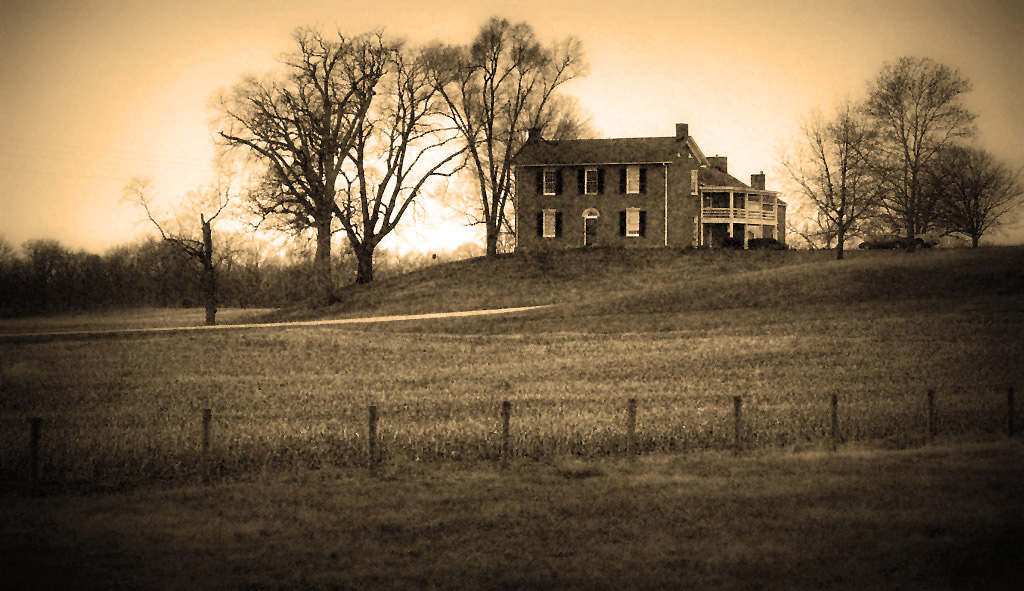
Image credit: “Ohio Farmhouse” by Don O’Brien/Flickr CC BY 2.0.