
Jul 24, 2026
By Valerie Dunham
The day my son turned a year old was a significant occasion in our home. I remember not being frustrated, for once, when he woke up at 3 AM, the time he was born a year before, hungry and asking for something to eat; I warmed him some milk, something my husband and I claimed we didn’t do anymore, and watched his grumpy face relax into relief. Several hours later, when dawn broke and Declan decided it was time to be up too, we went downstairs to make a special breakfast (pancakes, tater-tots, and more milk) before I had to go to work. When I got home that afternoon, I took him to the store so he could help pick out the cupcake he’d later smash into his face (and everywhere else—I honestly believe that frosting still haunts my kitchen). The picture of a chocolate-laden Declan still hangs in my office, and almost everyone who sees it fondly recalls their own child’s “first birthday cake” story. It’s such a universally treasured moment that many parents buy or bake a cake specifically for toddler hands to demolish (aptly named a “smash cake”).
Our son’s turning one was a momentous occasion in our home because it meant we had survived the onslaught of challenges a newborn presents. As new parents, my husband and I cherished the first year of our son’s life, but we also fumbled through it with little sleep and much caffeine. From the time he was born, Declan loved to eat. He never struggled to take a bottle, and even after we started giving him solid foods he would frequently wake up in the middle of the night expecting to be fed. This meant that I spent several hours every night awake, and several hours every day wishing I was asleep. Admittedly, Baby Wise turned into Baby Whatever Works, and consequently there were more nights than there should have been when I’d finally give in and warm him a bottle. It felt like losing a battle, and so when he finally started to outgrow this habit—a few months before he turned one—we were not only relieved, we were proud.
Tough as Stone
Sometime during the spring of 2013, just as Declan started to sleep through the night more frequently, I stumbled upon a Facebook group entitled “Prayers For Baby Stone.” Stone Anderson is a little boy only two months younger than Declan, and, though his parents didn’t know it when they welcomed him into the world, Stone was born with many medical complexities.
I was immediately drawn to his story. There was something about his big eyes and tender smile that made me think of my own baby and his family didn’t live too far from ours. Though I didn’t understand the complexities of Stone’s condition, the gist of it was clear: Stone was neither gaining weight nor growing in length, an anomaly that baffled nearly all of the physicians who examined him. He began being tube-fed a special formula, but it didn’t seem to be helping much. Suddenly waking to feed my son seemed less like a chore.
Nearly every day I looked for the updates Stone’s mom (Kelly) posted to his page. There were a few moments of progress but more accounts of no weight gained and no questions answered. Finally, there was a moment of clarity when Stone was officially diagnosed with a serious but rare disease called Eosinophilic esophagitis (or EoE), which was quickly followed by the heart wrenching moment when it became clear that Stone was essentially allergic to most foods.
The Importance of Food
Over the next few weeks I became hyper-aware of food. It was with a twinge of guilt in my heart that I carried on with my regular activities—my regular activities that, it seemed more and more, revolved largely around food.
I couldn’t hand Declan a bottle or a bowl of cheerios without feeling a strange sadness for a boy I’d never even met and for a fellow mom who never once asked for my sympathy. It wasn’t as if people with EoE were doomed to a life of dysfunction, or worse, a rapidly declining life. On the contrary, it seemed most people with EoE were able to manage the condition by ingesting a special formula, typically through a tube, but I couldn’t shake the feeling that Stone would be challenged in ways most are not—that he’d be missing out on something significant, though, at the time, I couldn’t have told you what that was. It was just food, right? As long as he’d be able to get his nutrition from somewhere, what did it really matter how he got it?
I didn’t fully understand my sadness for Stone until Declan turned a year old and I got to watch him gleefully devour the cupcake before him.
To fully appreciate the struggle of a human being born without the physical ability to digest most foods, it’s important to understand that food is not just food. Humans do not merely consume food for nutritional purposes; we turn it into an experience—the value of which is highlighted when you consider the fact that there are people who cannot partake in this food-experience.
Some of my favorite memories revolve around food.
When Declan turned four months old, I remember skipping cheerfully through the aisles of our local grocery store, a small jar of pureed sweet potatoes in my hand and the hope of a longer night’s sleep in my heart. Being a new mom, I didn’t know what to expect as I clumsily dipped the tiny spoon into the watery mess and brought it to my baby’s lips. His brown eyes widened as his brain tried to make sense of the new taste and texture for the first time, and, after a moment, his whole face lit up. Even though it did absolutely nothing to help him sleep better, this is one of my fondest memories.
The first place I always request to go to commemorate a special occasion is, naturally, a restaurant. The Homeplace is a well-known and dearly loved restaurant located just off the Appalachian Trail in Catawba, Virginia. College students, hikers, and families flock to the quaint establishment in droves, usually with a football or Frisbee in hand, because it’s not atypical to wait on the lawn for an hour or more to be seated. The menu isn’t complex—in fact, it really only provides a few choices—but then, the wild popularity of The Homeplace (and establishments like it) isn’t contingent on the sophistication of the menu items, but rather on the nostalgia home-cooked roast beef and fried chicken evokes. It harkens back memories of sitting around a table with family, enjoying conversation between bites of mashed potatoes and gravy
Even one of my favorite parts of planning a wedding was getting to taste-test the many cakes we had to choose from; one of my husband’s favorite parts of the big day was smashing said cake into my face.
In many ways, our lives—or at least many important parts of them—center on food. Bringing cupcakes into school for your birthday, filling plastic pumpkins up with Halloween candy, attaching a box of cheap candy hearts to an even cheaper valentine, attending pizza parties, chasing the ice-cream truck during the hot summer months, begging your mom for popcorn at the movie theater, learning to cook your first meal, surviving off of little more than Ramen noodles in college, coming home to your favorite meal, preparing a candlelit dinner for your significant other, hiding an engagement ring in a cupcake (for the record, I don’t actually recommend this)—all of these things are practically rites of passage in American culture. None of these things are open to children who suffer of conditions like EoE, and that’s where my sadness came from.
Imagine trying to include your son in family dinners but having to deny him the spaghetti and meatballs his sister was eating. Imagine watching all of your friends gorge themselves on pizza while you added more formula to the machine that would tube-feed you. Imagine getting married one day and letting your new bride smear cake on your face, knowing if you accidentally swallowed any you’d pay dearly for it in pain later.
Not just food, but the food-experience is everywhere in our culture.
Is My Fondness For The Food-Experience Sinful?
I grappled with this question for a long time. I oscillated between guilt and indifference as I continued to plan for Declan’s first birthday party, which was scheduled for the week after his actual birthday, and which mostly revolved around two things: the cake and the Pinterest-esque recipes I was endeavoring.
The first question I asked myself is probably the most obvious, and one that addresses what is perhaps a rising concern in American culture: Is our fondness for food an indication of gluttony?
To answer this question I sketched out a basic definition of what most accept gluttony to be, which is the overindulgence of something (often food). I can name at least three occasions every year on which I partake in gluttony, but I can think of many more (every day) on which I enjoy the food I consume without overindulging in it.
Still, what was perhaps a self-imposed guilt continued to weigh on my heart, particularly as I read about a small but growing trend of men and women who were challenging themselves to live on formula only—a diet much like those who suffer of EoE; this sparked a far more productive question in my mind: Why do we long to enjoy food?
More than Survival
I hate running. I’m a good runner, but I hate doing it. Ironically enough, it was while running (hobbling along) that I began to think of Stone, and Declan’s impending birthday party, and whether or not I was wrong to contribute to a culture that places so much emphasis on food by featuring it so prominently at his party. What kind of statement might I make if I excluded the practically obligatory birthday cake from the event? How uncomfortably hungry would everybody be if I didn’t provide snacks? Would my husband ever speak to me again if I subbed out the frivolous party foods everyone would be expecting for vegetables instead?
It was right around the time that I justified foregoing that last mile for a later game of soccer that the thought dawned on me:
We strive to enjoy food for the same reasons we strive to enjoy exercise or sleep. All of these things are bodily functions necessary for the upkeep of one’s health, but they are also things society promotes as enjoyable activities. Rather than partake in an onslaught of physically demanding drills, we have created games like soccer, basketball, and football. Instead of crawling onto a standard-issue cot for a standard-issue sleep every evening, most of us crawl between smooth sheets and drift off atop a soft pillow. Though any of us could opt to live off of the formula children like Stone survive on, most of us choose otherwise.
God created humans with an instinct to not only survive, but to cherish life. Our entire existence confirms this. God did not need mankind, but here we are. Not needing something but desiring it anyway is not inherently wrong. God was not incomplete without us, but our creation was not frivolous, it was and is good.
In the same way, we don’t need food to fill the role our society casts it in. We don’t need to attach it to rites of passage and celebrations. We could do without Thanksgiving turkeys and Christmas cookies and birthday cake, and perhaps, on some level, we should. At the very least, we should monitor our tendency for gluttony—particularly on the big occasions it seems socially acceptable. But we do not necessarily use food as a method of enjoyment because we’re gluttons; we do this because we’re created with an instinct to enjoy the things that sustain us.
What an Enjoyment of Food Says About Humans
God could have created man with the ability to partake in nutrition differently—He could have created man with no need for nutrition at all. The fact that He didn’t, however, has allowed us to visualize our dependency on Him. God has used hunger to allude to a deeper hunger of the soul; He has used thirst to describe the drink that can sustain a man eternally. Our need for physical nutrition parallels a spiritual need for nourishment as well.
Perhaps our enjoyment of food similarly parallels the fact that we are called not only to be sustained by relationship with God, but to savor the richness of it. As is frequently the case, perhaps the tangibility of a human tendency is a pale mirror of the same spiritual tendencies.
Food is as temporary as this life. It can comfort, but only for a moment; it can bring joy, but it will stale over time; it can sustain you, but only as long as you return for more; and it can satisfy your hunger but cannot satisfy your soul.
We are born with an innate understanding of how vitally important food is to our survival; what we are more prone to overlook, however, is how much we value not just food, but the food-experience. I didn’t consider the many ways the food-experience weaved in and out of our culture—my daily life—until I started to pray for a boy who could not partake in the food experience. Declan will probably not understand the full weight of food in his life for a long time, if ever, because he has access to it. To him, birthday cake will probably just be birthday cake—a treat he gets once a year that hopefully Mom won’t mess up too badly. But Stone will likely understand something most don’t: food does more than physically sustain a life, it enriches our survival experience; and though I never thought of my relationship with God in this way before Stone, I am thankful that He has called me to digest it with joy and not just necessity.
Val graduated from Liberty University in 2011 with a B.A in English. Though she’s originally from Cape Cod, Massachusetts, she currently lives in Blacksburg, VA with her husband, Matt, and son, Declan. In her free time, Val enjoys writing, watching any and every Boston sporting event, and volunteering at Cambria Baptist Church.
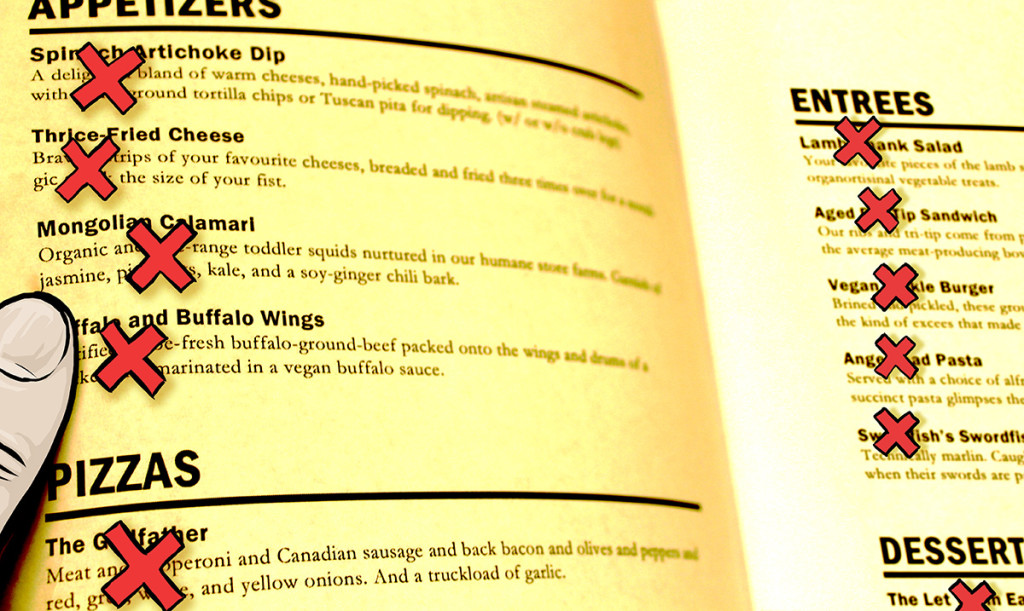
Illustration courtesy of Seth T. Hahne. Check out Seth’s graphic novel and comic review site, Good Ok Bad.