
Jul 24, 2026
By Alan Noble
From the time we first sit down in the booth with our fountain drinks it begins to nag at me.
I probably have five minutes before our numbers are called, which doesn’t leave me much time between our conversation to decide whether I should pray or not. I can’t remember if my friend is the kind who prays before meals in public. I bet he prays at home, and maybe even with his family at restaurants, but this is fast food and it’s just the two of us. Plus, it’s lunch time. I get praying for dinner, but lunch?
I just hope they call our numbers together. If I get my food first I’ll have to sit there waiting for him to get his food. And if I take a few bites he’s going to think that I don’t give thanks. Do I? I’m not sure. I don’t exactly know when I’m supposed to pray and when not to. A burger and fries hardly seems worth the effort. Besides, can I really ask God to bless junk food to my body? I’ll make that joke if he asks to pray. That’ll make things less awkward.
Gosh, I hope he doesn’t decide to pray right when an employee comes up to give us refills or something. It’s not that I’m ashamed to be seen praying in public; it’s just that I feel so exposed. I don’t want people to think I’m showing off. Why can’t we just all agree that this isn’t necessary? I’m thinking way too much about this. Blessing a meal shouldn’t turn into a law. Jesus didn’t command us to pray before burgers and fries, so I don’t have to feel guilty about this. We have freedom in Christ. I can just say a prayer inside my head. That’s good enough. As long as my friend doesn’t say anything, I won’t either. And anyway, this conversation we’re having is really spiritual. It’s kinda like it’s own prayer.
Don’t make things awkward, please. Let’s just eat.
This stream-of-consciousness script has run through my head hundreds of times. It reveals my own poor theology of gratitude. But perhaps it reveals more about how deeply the modern, secular separation of the public self and private faith has influenced me. And maybe that’s exactly why I need to bless my meals. Of course there is the scriptural precedent for it: Jesus blessed the Passover meal at the institution of the Lord’s Supper and He blessed the five loaves and two fish. These aren’t exactly commands, but they do show that it was the accepted norm to give thanks before meals. In our culture, however, it’s a fairly radical act.
It’s radical because it goes against everything the food industry and science and technology and commerce has taught us about provision and gratitude–all meals are always, fundamentally gifts from God and only secondarily the produce of our labor.
It’s radical because it challenges the secular conception of religion as a private, individually-held, cognitive, belief. Saying Grace is a public act—done in a public space and within the hearing of all around us. It is communal—an act shared with those we eat with. And it is embodied—it disrupts our activity, causing us to physically stop to give thanks before eating.
Our relationship to food will be formed by our habits of consumption, for good or for ill. Giving thanks, even when it makes us uncomfortable, reorients us toward God’s grace. To “say Grace” is to pronounce the Grace already before us, itself a sign of all God’s grace for us.
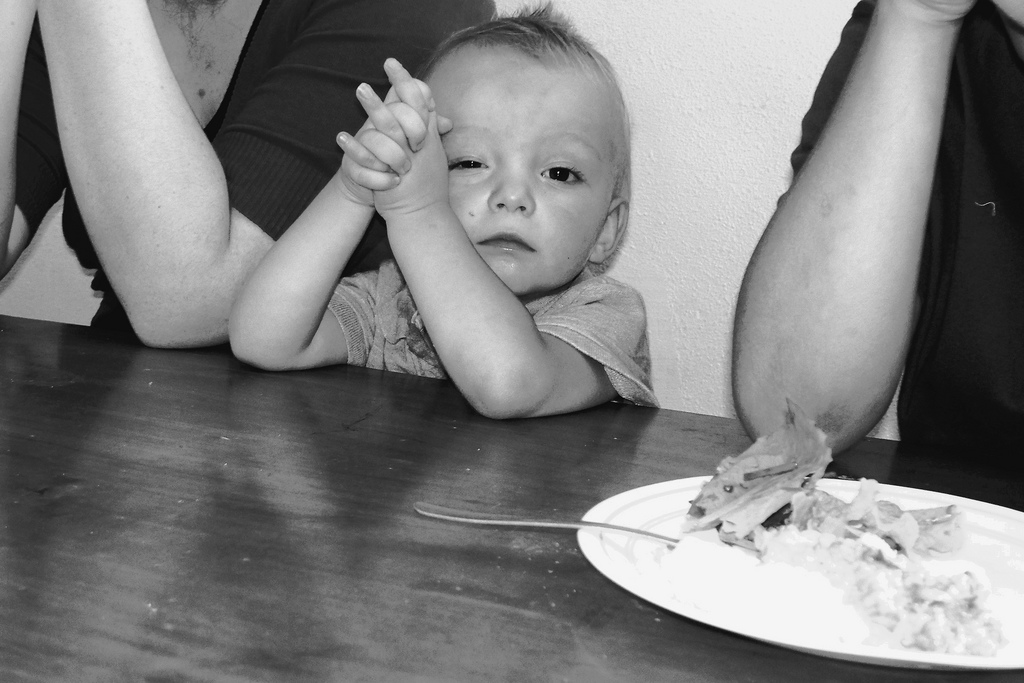
Image: “Child while food is blessed 1” by Zechariah Judy/Flickr CC BY 2.0