
Jul 24, 2026
By Kevin Schut
I have a secret weapon I pull out when I’m trying to impress fellow nerds of a certain age: a video game collection. It’s not just any old collection. It is an old collection. When I started teaching at Trinity Western University, my supervisors gave me a budget to start amassing a set of old machines and games, so even though I haven’t bought anything for ages, I’ve got just about everything covered, from the Atari 2600 and Commodore 64 through the Sega Master System, Atari Jaguar, and Amiga 500 to the Sega Dreamcast and Nintendo GameCube.
If this doesn’t sound exciting to you, you obviously didn’t grow up in the late 70s through the early 90s as a geeky guy with a penchant for fantasy novels, an inclination to dabble in programming, and a taste for Monty Python. Oddly enough, there are more than a few of us, and the reason I score nerd points is that I have access to the toys we loved then . . . and never stopped loving, ever. And I know more than a few guys who stockpile geek paraphernalia–Star Trek collectibles, foil-colored Legend of the Five Rings cards, LEGO Christmas village sets–that seem to inspire an inordinate amount of glee well into our 40s.
This behavior isn’t just limited to a geek subculture. We’ve gotten used to grown men never growing up. We don’t blink an eye at college graduates playing Pokemon, young dads doing cosplay at comic-cons, middle-aged men splurging on a sports car, and 60-somethings doting on sailboats. Toys are central to the life of today’s men—at least in the comfortable middle class. It’s not just men, of course. We all know that girls just wanna have fun. But our consumer culture markets a particularly potent brand of toy obsession to guys.
I am using the word “toy” rather broadly here: it basically means “plaything.” And we have an awful lot of stuff we can play with, and in a lot of different ways: video games, obviously, but also climbing gear, smart phones, 3D televisions, cordless drills, and much more. These aren’t all toys for every guy. Wood chippers, for instance, freak me out. But some men will go searching for a yard that needs to be cleaned just so they can spend some time grinding branches and spewing out wood chips—for them, it’s just like going back to the sandbox and the Tonka trucks. One thread that runs through my video game play and Mountain Man’s brush clearing is that we’re getting juiced by goofing off with our playthings. The other thread running through our play is that toys cost something: often money, and always time.
It is this cost that often leads to a negative perception of toys in Christian circles. The church has a long history of frowning at things it perceives as frivolous and wasteful, and toys clearly qualify as both. But is this fair? Are boys’ toys in tune with gospel values? What does God think about our association of men and play? Are toys no more than wasteful distractions, or can they encourage a healthy attitude toward life and play?
The modern history of the Eternal Boy
Interestingly, it’s a relatively new development to idealize the boy who never grows up. In the Victorian era, for instance, society valued men for their productivity and responsibility. In the Gilded Era, culture called men to be muscular, bullying titans. But ever since the beginning of the Consumer Age, advertisers and opinion leaders have called on men to lighten up, to play, and to buy toys.
Historian Woody Register calls this ideal “the eternal boy.” He argues that characters like Peter Pan and public figures like the amusement park entrepreneur Fred Thompson popularized the notion of men never growing up, and that this happened at a convenient point in history.
Convenient how? The U.S. and other western nations were transitioning in the late 1800s from an economy focused on production to an economy focused on consumption. Advertising switched from boring, tiny font to colorful, emotional images. Magazines extolled the joys of hobbies and vacations and home decoration. Labor laws and the rapid growth of big cities meant there were large crowds of people with both time, opportunity and money to spend on entertainment. As the primer purchasers of household goods, women were already good consumers, and advertisers worked hard to burnish character types like the Happy Homemaker and Supermom (for a great history on this, check out The Age of Persuasion’s podcast entitled “The Happy Homemaker“). However, men focused on responsible productivity or power trips didn’t fit well in a culture like this. Advertisers needed a better potential market. Boys who never really grew up? Perfect. They’d never stop buying toys, and that’s the way advertisers liked it.
And that’s the way it still is today. It’s not that responsibility and strength and wisdom are not qualities that we value in men—those values are still around. But they’re joined—and to some degree dominated—by the ideal of the eternal boy and his toys. Men in ads are always smiling, often playing. Grown men invest hundreds of hours per year into podcasts on TV shows, and serious broadcasters spend real money on online YouTube series dedicated to talking about video games (here’s looking at you, PBS). A common theme in our popular narratives is that men need to lighten up, to enjoy life, to be—with apologies to Pharrell Williams—happy. Being suave is fine, being strong is great, but men should not be without a sense of humour. Even James Bond, that paragon of manliness, isn’t complete without his arsenal of deadly toys.
Toys for the self: play as narcissism
There’s a lot to dislike about the way we’ve surgically grafted fun into our concept of manhood today. There are, for instance, a lot of guys who get obsessive about their toys. As someone who studies video games, I see and hear a lot about this. Many games encourage never ending play, and for certain types of people, double-clicking the icon is a one-way trip to Azeroth with very little chance of return. What’s particularly awful about some kinds of compulsive play is that at a certain point, addiction research and personal experience show that the game ceases to be fun and becomes more about habit and need. The player’s brain gets stuck like a broken record, playing the same sequence over and over again, and life becomes a joyless slog. And while game players are particularly prone to this kind of thing, it can also happen with stamp collecting, reading, and furniture making. Of course, it’s not just men who get hooked on toys, but it sometimes seems like they’re particularly prone to such traps.
But even if toys aren’t addictive, men often use them to escape responsibilities they shouldn’t be shirking. I can’t tell you how many times I stopped writing this article in order to play “just one more round” of Hearthstone. The games I like can pull me away from my grading, from time with my family, from prayer and spiritual discipline. Men in our culture hear over and over again about the importance of fun, and so toys can assume a role of unhealthy importance.
This may seem like a kind of grumpy old man take on things. Haven’t men always had a penchant for this kind of stuff? Go far back enough and the complaints about video games and obsessive car waxing get replaced with whining about dicing and drinking. And I think there’s something to this point. As imperfect people, men (and women, for that matter) have always found entertaining ways to avoid responsibilities they should take seriously.
But I also think that some of the historic norms that used to counterbalance these tendencies have weakened somewhat, and more importantly, we have an entire global industry dedicated to teaching men to avoid responsibility. Changing gender expectations are remarkably complex things, but it is probably fair to say that when the Victorian notion of the family was stronger, there was greater social pressure than today for men to be responsible fathers and husbands. That is, it’s easier for men to abandon or neglect their families today and avoid social disapproval than, say, fifty years ago. (As an aside, I don’t think that necessarily means that everything about families fifty years ago was healthier than families today: I’m just talking about this particular aspect of family dynamics.)
Whether you agree with that assessment or not, however, there is no question that we have worldwide consumer message machine dedicated to encouraging irresponsible consumption. Wherever we turn, we see ads pushing the idea that men should throw off the shackles of duty and seriousness that might prevent them from playing. For example, the “most interesting man in the world” from the Dos Equis commercials may be a joke, but it’s still worth noting that as the ultimate playboy type, he’s not interesting because he’s a responsible father–he has liberated himself from the conventions of responsibility. In consumer technology commercials, dorky guys throw off the sensible, fiscally responsible, but boring burdens of credit card limits while hyperventilating over the newest phoneputerscreenspeakercam thingy. But the purest form of glorified irresponsibility I’ve seen is the slogan of my local NHL team, the Vancouver Canucks. During the playoffs they proudly proclaim: “this is what we live for.”
Toys for humanity: play and shalom
As bad as this all sounds, however, I think we can also make a biblical case for toys potentially being positive. While the Bible, to my knowledge, never directly addresses toys, there are several levels on which God’s Word celebrates and promotes play.
There’s certainly no prophetic attack on toys, and given that the Israelites adopted much of the technology and lifestyle of their neighbors, it’s reasonable to think that children had playthings, like just about every culture we know of. That’s not exactly a ringing endorsement of toys and play, but it at least suggests that toys aren’t inherently problematic in the Judeo-Christian tradition.
A more positive consistent Biblical motif is that of the feast. Cultures that are closer to subsistence levels than our own prosperous civilization unsurprisingly often have a more grim sense of determination and struggle for survival. Yet practically every culture makes time for celebration, no matter how materially poor they are; medieval Europeans, for example, had almost as many feast days as work days. The Bible makes similar kinds of provisions for the Israelites with things like the Festival of Booths and the Year of Jubilee. Not only that, but the kinds of feasts the Bible features do not suggest restraint. It’s always struck me as amusing that the master of ceremonies at the wedding in Cana made it pretty clear that most hosts left their worst wine for the end of the feast, presumably because most guests were no longer in a state to bother with some snooty cork sniffing—and that’s the point at which Jesus gives them more of the good stuff!
This tradition of feasting does not directly speak to toys, of course, but it does speak to play, to the parts of life we might sometimes identify as frivolous. Specifically, it shows that God has built us for more than productivity and more than duty, as good as those things are. We are also built to enjoy freedom, to enjoy relaxation, to spend time with friends just playing–and toys are a key part of that kind of activity. Yes, sometimes biblical writers critiqued feasting, but most often the feasting itself wasn’t the problem, it was feasting by people who practiced injustice and neglected the poor. When our lives are in tune with God, celebration and play are core to who we are. As Tony Campolo puts it, the Kingdom of God is a party.
I also see a playful attitude in the image of the Creator God. The early chapters of Genesis conjure up a picture of Yahweh as a great LEGO tinker, a playful, creative mind that just likes to try stuff. Our own LEGO, our canvas and paint, our building blocks, our video games are kind of pale imitations of the One who threw stars into space and thought the duck-billed platypus was a pretty good idea. But our mimicry of God is important, because that’s how we learn about Him. For instance, our own love may only be a watery shadow of the Greatest Love, but it is what allows us to get a sense of God. Play is part of who God is, so our own play is one route for us to get to know Dad.
The toys facilitate that play, that spawn joy, that enable celebration, that spark creativity, that give us a taste of the person of God: such playthings are good. And I really do believe that there are an awful lot of toys that can do this, from pickup trucks to collectible Star Wars figurines.
The toy as a black hole or a fountain
The essential difference is this: healthy play looks outward, unhealthy play looks inward. And this, in the end is as true for women as it is for men. Play can be selfish, focused on fun, no matter the consequences, no matter what it does to the relationships we have our loved ones. This is the trap that toys can pose for boys of all ages. When toys become all about taking in and never giving out, they start to kill us. If all I ever want to do is play my video games, or go to the climbing wall, or work in my shop with tools, or take my ATV out in the backwoods, how do I have time for my kids or my wife or my friends? How would I have time and energy for prayer, for living in and building my church community? Would I have room in my life for conversations or thoughts that produce spiritual and personal maturity and growth? I know from personal experience that when a toy becomes too important, I run the risk of walling myself off from anything my own little pleasure.
But toys don’t have to be like this. Play can lead to joy, can lead to community, can lead to a refreshed view on life. Gamers can build great relationships because of the games they play. Anyone who’s watched a child create imaginary worlds with a few sticks, blankets and stuffed animals knows the joy that toys can bring; this is true for adults as well. And in the middle of suffering and stress, toys can temporarily pull us away from the grime of the daily slog. God built us partly to enjoy His Creation, and toys are often key to that enjoyment. If we don’t grip them too tightly, if we’re ready to put them away when it’s time to clean up, if we’re ready to share them with others, all of these things, from games to replica jerseys to wood chippers, can be part of what it means to be created in the image of God.
Kevin Schut is a Professor of Media + Communication and Associate Dean of the School of the Arts, Media + Culture at Trinity Western University in Langley, BC, Canada. He’s written the book Of Games and God: A Christian Exploration of Video Games, and loves playing LEGO games with his 3 daughters.
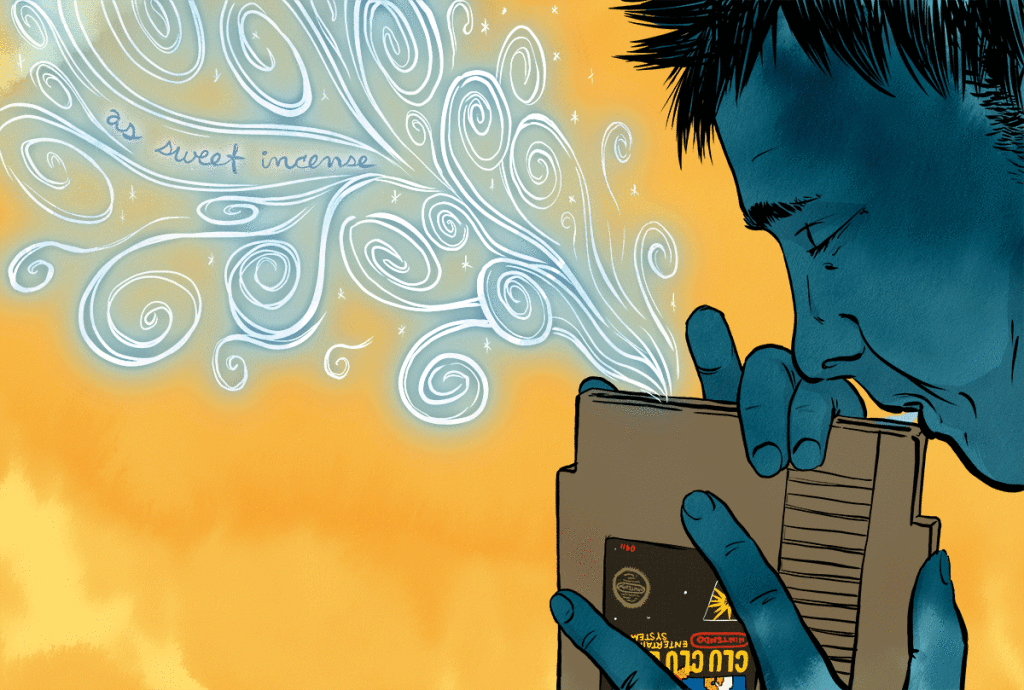
Illustration courtesy of Seth T. Hahne. Check out Seth’s graphic novel and comic review site, Good Ok Bad.
[button link=”http://christandpopculture.com/membersonly/capc-mag-volume-2-issue-12-toys-make-us/” size=”medium”]Return to CAPC Mag Volume 2, Issue 12: The Toys that Make Us[/button]