Jul 24, 2026
By Ryan E.C. Hamm
Right before Christmas, I found out I was going to be a dad. There was the usual flood of emotions—terror, excitement, joy, pride, love. And underpinning them all, the question that still keeps me up at night if I let myself think about it too hard:
How am I supposed to be someone’s father?
It’s a daunting role—somehow, I’ve been given the chance to raise a child, to decide huge portions of their lives for them, to form them, to train them up in the ways they should go and all of that. It’s a privilege, but if someone says they’re not terrified they’re either lying or in some serious denial.
As the reality sank in, I started to think about how to prepare for the arrival of our son or daughter. There were the obvious preparations of registering and finding a midwife and so on. But there were other things that really mattered to me. I want to make sure our baby learns about the things we love, the things that have made my wife and I who we are. I want our son or daughter to learn the music we love, find out about the God we serve, discover how awesome the Star Wars original trilogy is (not necessarily in that order). In short, I began to think about the kind of legacy I want our baby to start with.
And one of the legacies I most want our baby to start with is a toy. A toy called Nintendo.
A buddy named Mario
Growing up, my parents were pretty strict about TV but were particularly strict about video games. I never had the newest, best system—I got a hand-me-down Nintendo and Game Boy, and spent at least one year of elementary school praying for a Super Nintendo that I never got (my parents made sure to have me preface said prayer with “If it’s Your will,” so don’t worry).
But somehow, some of my favorite memories of childhood are tied to that gray, black and red toy. My sister and I spent hours beating every level of Super Mario Bros. 3 while listening to whole volumes of Adventures in Odyssey. My dad and I played Super Tecmo Bowl together (until I started being able to beat him regularly). My brother, 11 years my junior, and I bonded over games of Mario—I even got him Super Mario Bros. 2 for Christmas, in 2001.
I’ve returned to these Nintendo games over and over again. And my collection has grown as I’ve gotten older—I’ve gotten to experience some of the games I missed on the systems I didn’t have as a kid, and many of them gave me that feeling I had playing Mario 3 for the first time. It’s not just the memories that make these games something important to me (and plenty of other people)—it’s that feeling of sheer enjoyment, of playing something fun that both challenged and delighted me.
The Nintendo games of my youth aren’t entries into the never-ending “Are video games art?” debate (spoiler: yes). They’re not telling me deeper truths about the world, or helping me walk in the steps of someone I’ve never met. Games do this, and it’s important they do so—games like Gone Home or The Walking Dead make us think about what it means to be human, and even big-budget AAA games like Bioshock Infinite ask us questions about fate and morality that aren’t easily dismissed or explained away. These are games that are as thought-provoking and moving as any piece in a more widely-accepted medium. But they’re not toys.
Sure, I want my daughter or son to play the “important” games, to know and experience great art. But I also want him or her to play with the Nintendo toys I loved so much as a kid. Mario, Donkey Kong, The Legend of Zelda, Kirby, Yoshi and all of their incarnations are wonderful examples of game design, creativity and charming premises (annoyingly common princess-rescue trope aside). But I don’t love Nintendo games for those reasons—I love them because they put a big, dumb grin on my face. I love them because they’re fun.
Blessed are those who have fun
The idea of pure fun or play as an end in and of itself (rather than as a convenient by-product of another task) can easily be overlooked in the modern Christian life, at least in America. Much of our time is spent either mind-numbingly consuming whatever movie, TV show, website or video game happens to be available, or trying to divine a “deeper meaning” that we shoehorn into whatever we want to watch/do so we can feel better about it. Just Google “Jesus” and whatever pop culture figure you like—chances are, some Christian somewhere has made a case for why the cultural artifact is True and Good, to varying degrees of success (Breaking Bad as a symbol of evil run amok? Sure. Two and a Half Men as indicative of the changing paradigm of the American family? Kind of a stretch).
Of course, there is nothing wrong with being a discerning viewer, or with looking for God’s truth in the messages we receive from the media we engage with. In fact, those things are very good things, important to living out the Christian life in modern culture. But sometimes, Christians can take that a little overboard. We tend to want to find a hidden meaning in everything we enjoy, even if it doesn’t really need it. I suspect some of us even feel guilty from time to time about the things we enjoy—I remember trying to understand for ages why I liked Ocean’s 11 so much when it was so silly. Surely, to enjoy something means it must have a point for the discerning Christian, right?
But when everything has to have some kind of secret layer to be “good,” when everything needs to have a hidden meaning that tells a deeper truth, when everything needs to inspire thoughts about life/art/God/love/etc., we lose something: we lose our ability to allow delight into our lives that’s simply joy-giving fun.
The wonder of play is that it doesn’t need to have a “point.” I don’t mean that fun for fun’s sake isn’t a point in and of itself—it is! I mean that there’s no utilitarian purpose to having fun. We’re not “doing” anything, or at least anything of perceived cultural value. Using your imagination to build a Lego set doesn’t really serve a purpose. It doesn’t have a deeper meaning (unless you really want to stretch your Lord of the Rings Lego set into some kind of ex nihilo metaphor). The sheer delight in playing with a child’s favorite toy doesn’t have some hidden agenda for you to parse. Super Mario Bros. 3 isn’t providing socio-political commentary that will change your worldview. These things are just fun. It’s the end goal, not something to gloss over on the way to finding the point that matters. Joy itself is the thing that matters.
This is a tricky balance. So much of what we consume as Christians, or how we play (either as adults or as children), has the ability to render us numb to the problems or sins of this world. Mario Kart 8 is wonderful, but becomes wicked and no longer fun if it causes me to stop caring about my wife. LEGOs are great, but not when your daughter becomes defiant about picking them up and it becomes a cause for discipline. Drawing pictures is a wonderful way to experience and share joy until your son spends the evenings wrapped in his art at the expense of his loved ones. We can use fun things, good gifts, to escape.
Similarly, we can also take the fun out of things by over-analysis. Your kid doesn’t want to hear how his LEGO sculpture is indicative of mid-century Bauhaus anymore than your daughter wants to hear your detailed analysis of the sibling relationship between the Mario and Luigi. We can bleed the delight out of our joy in ways that leaves our fun inert and lifeless.
In our delight when we experience—and particularly when we share in the experience—the fun of play, we remember what it’s like to be children again, before we learned what it meant to worry about discernment, before we were exposed to mindless drivel that deadens our hearts and minds. It’s not just the toys of our youth (or toys in general) that bring us this pleasure, but often they can be powerful reminders of what that pleasure feels like, what unfettered joy is.
The first time I went to Disney World as an adult, none of my cynicism about Walt Disney Company mattered. I saw a giant mouse made of flowers in a front lawn, saw Donald Duck high-fiving kids and heard the music of all the movies of my youth and the memories of fun with family, friends and that ache of remembrance came flooding back. It was more than empty nostalgia, because it pushed me to want to make memories with my new family. Now, the memories of my wife insisting we stand in line for 30 minutes to meet Woody, or the time my friend’s face lit up when she saw Ariel the mermaid in the middle of a 3D movie, or the times we heard our friend’s baby’s name for the first time stand out just as tall as the memories of being a kid. We were having fun, and it was wonderful.
Plenty has been written about what Jesus meant when he said “Let the little children come to me” and that the Kingdom of Heaven belonged to people who were like kids. And it probably means a whole lot of things. But I’d like to think the Jesus who had so much fun that people suspected him of being a drunkard and a glutton, who performed His first miracle to keep a party going, and who seems more than at ease at long dinner parties, knew and appreciated that kids like to play. The Gospels are silent on whether or not Jesus played as a child, but it’s not hard to imagine the boy Yeshua wandering around Nazareth with a set of jacks, or ready to play checkers. Jesus “came eating and drinking” (Matthew 11:19) who liked to tell jokes in his parables and poke fun at his disciples. He’s someone who values humor and joy.
But above all, human beings are made in the image of God. While that is a deeply mysterious fact, it leaves us with the knowledge that somehow our character traits, feelings and personalities are reflected (and perfected) in God. We’re fallen—but I don’t believe that fun and play are part of the fall. When we have fun, when we play, we’re doing something that matters—we’re experiencing Joy, a fruit of the spirit. It enlivens our hearts, uniting us with the Giver of joy. We play with others, honoring God with our joy and uniting with others in our fun. Toys, in their proper place, are a part of that.
Not everyone will experience fun with the same toys or in the same way. Not everyone needs to buy a Wii U. Maybe our child will hate Mario Kart 8 and we’ll have to find some other joy-giving activity to do together. But when I think about the legacy I want our baby to start with, it’s one where they see their parents worshiping a God who delights when they have a smile on their faces. I want them to see a Jesus who cracks a grin. And when they’re older, have been hurt and are a little more cynical, and our son or daughter wonders why we waste time playing these stupid games, I want to tell them “We play because we it’s fun” and remember that that means something.
Ryan E.C. Hamm is a writer and editor who lives in Cleveland, and actually likes it. Follow him on twitter @ryanechamm or visit RyanECHamm.com.
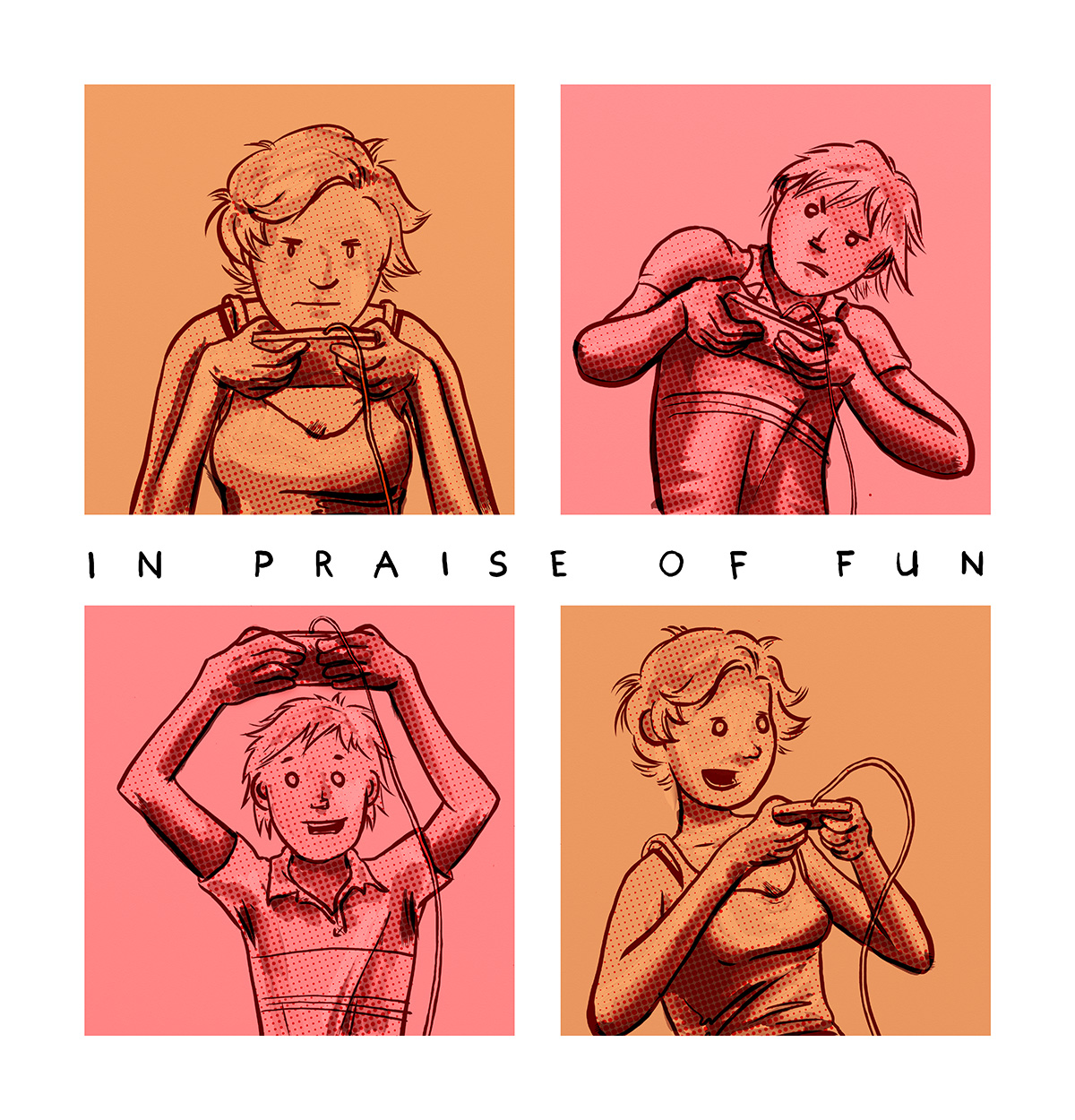
Illustration courtesy of Seth T. Hahne. Check out Seth’s graphic novel and comic review site, Good Ok Bad.
[button link=”http://christandpopculture.com/membersonly/capc-mag-volume-2-issue-12-toys-make-us/” size=”medium”]Return to CAPC Mag Volume 2, Issue 12: The Toys that Make Us[/button]