
Jul 24, 2026
Featured in each issue of Christ and Pop Culture Magazine, “Citizenship Confusion” by Alan Noble looks at how we confuse our heavenly citizenship with our citizenship to the state, culture, and world.
To make sure you don’t miss an installment of Citizenship Confusion, become a member.
In the several years I’ve been writing this column, I’ve only dared to question the sacredness of military service once. This, despite the fact that a sacred view of military service to the State is probably the most notable example of “citizenship confusion” in our country. My trepidation to write on this subject is not due to a belief that it is too obvious to warrant an article, or due to doubts about whether or not civic religion is a problem for us. My hesitation is the fear of the taboo, the fear of blaspheming something holy in our culture. Our country actively promotes the idea that military service, and particularly injury and death in combat, is sacred, a righteous sacrifice on the altar of freedom. As Thomas Jefferson once said, according to numerous Facebook Memes, “The tree of liberty must be refreshed from time to time with the blood of patriots and tyrants. It is it’s natural manure.” This rhetoric dishonors the work of service men and women, allows us to make dangerous foreign policy decisions, and blinds us to the realities of war.
The meaning of death in service has been a popular topic of debate again with the gains of ISIS in Iraq, as they have seemingly undone all the great work our military has spent years and billions of dollars—and so many lives—to accomplish. Many on the Right have critiqued President Obama for failing to act swiftly and with military might to stop ISIS. And now, with Iraq back in the middle of a civil war, some have claimed that our soldiers “died in vain” because of Obama’s negligence. In response to this criticism, Gary Bauer, former president of Family Research Council and current president of American Values, wrote an op-ed for The Daily Caller arguing that death in combat can never be in vain, because it partakes in something much greater than itself:
“Those who serve in our military serve a higher purpose than whatever is at stake in the immediate battle. It is a principle that does not depend on public opinion polls, on partisan politics, or even on whether we ultimately triumph or fail in any given war.”
Bauer ascribes a transcendent significance to military sacrifice; the meaning of such sacrifice is unaffected by all the immediate circumstances of a military conflict. Note the religious language here. A “higher purpose” evokes the idea of a divine calling, a sacred mission. But just what is this sacred mission? Perhaps to answer this question, Bauer quotes former chairman of the Joint Chiefs of Staff Mike Mullen next:
“Regardless of the terms of the treaty, the surrender, the withdrawal, the defeat or the victory, no American who sheds blood to preserve that which his ancestors fought to establish can ever be said to have made that sacrifice without meaning. . . . We should remember that what qualifies a life well-lived and honorably lost is not merely victory on the battlefield but the nobility of the struggle itself—the courage to take up arms in pursuit of something large.”
Mullen and Bauer assume that the American in this scenario “sheds blood to preserve that which his ancestors fought to establish.” But what about when a conflict doesn’t actually preserve our country? Interestingly, Bauer evades this all-important question by claiming that the war in Iraq was actually effective at preserving our country.
Bauer argues that regardless of what state Iraq is currently in, “Our brave men and women in uniform have brought us nearly thirteen years in which to start families and raise children, worship God, live in freedom, and otherwise go about our lives, without experiencing another horrible attack on our homeland.” And therefore, their sacrifice was not in vain. This claim is strange, to say the least, because it requires us to believe that had we not invaded Iraq, we would actually have had more terrorist attacks on the United States, even though Iraq was not responsible for 9/11. Then it requires us to deny that the war in Iraq turned into one big terrorism recruitment drive, which it almost certainly did. It also requires us to ignore the fact that the occupation did not bring Iraqis “nearly thirteen years in which to start families and raise children, worship God, and live in freedom, without experiencing another horrible attack.” Dear God! Thanks in large part to the invasion and occupation which these soldiers sacrificed for, the last Christians have left Mosul and the Christian church in Iraq is nearly gone. It takes a lot of imagination to believe that the war in Iraq preserved our country for thirteen years.
Whether or not Iraq preserved us doesn’t matter, argues Bauer, because the honor is in the struggle, not the outcome. This rhetoric is really about existential justification. What Mullen and Bauer are arguing is that in some religious sense, a soldier’s sacrifice validates his or her existence in the world. Notice the language used in this debate. We are asking whether someone’s death had meaning, as if the right sort of narrative to one’s life can determine whether or not that life was good. Mullen tells us “what qualifies a life well-lived and honorable lost,” which is a rather transparent way to talk about what justifies a person. What will validate your life, marking it as good, meaningful, purposeful, and honorable? One answer, apparently, is a willingness to fight and die. We are assured that the “nobility of the struggle itself” is enough to justify us, the “pursuit of something large.” The soldier who risks everything for some “large” purpose in a grand struggle is justified merely by choosing to join that struggle and accept that risk (readers of Cormac McCarthy’s Blood Meridian remember similar rhetoric coming from Judge Holden—a frightening parallel).
This might sound good when we envision a U.S. soldier, but the ideology very quickly breaks down once you imagine, say, an Islamic extremist adopting the same ideology. I’m sure that most members of ISIS believe that they too are justified by the “nobility” of their “struggle” and their “pursuit of something large” (a global caliphate); certainly the Nazis thought this way. The danger in this philosophy of warfare is that it’s morally neutral. All that matters is that the soldier gambles everything for some greater purpose.
Seen in this way, it becomes clear that our country has wrongly made military service and sacrifice into sacred acts. This is nothing less than a false gospel, with the State as a false god.
None of this belittles or dishonors the sacrifices made by service people, or their courage or honor. Nor does it mean that we do not owe them thanks. In fact, rejecting the lie of military-service as salvation allows us to rightly be grateful. And more important, it allows us to accurately consider when a conflict and the sacrifices it will require is actually worth those casualties. It lets us to look back at conflicts like the war in Iraq and admit that many of those soldiers lost their lives for a cause that did not lead to our freedom or Iraqi freedom. This may lead us to some startling conclusions. It may lead us anger or frustration over so many senseless casualties. But the alternative is a blind faith in the goodness of military sacrifice in service of the State.
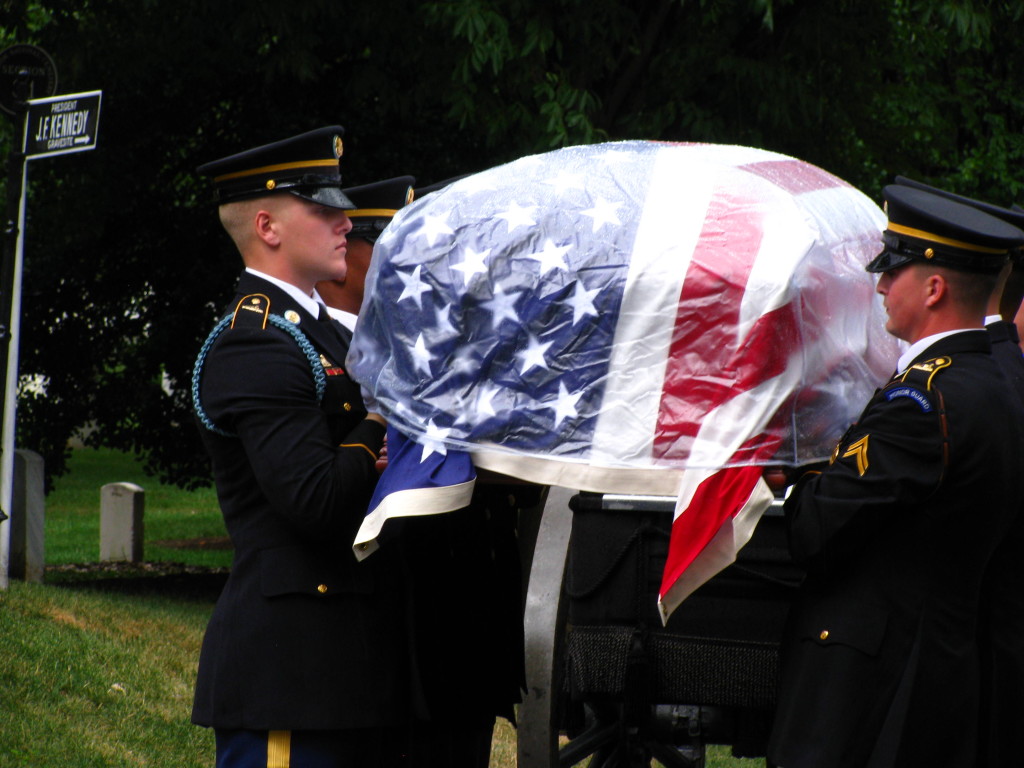
Image: “Transferring to the Gravesite” by Alex Ford/Flickr CCBY2.0
[button link=”http://christandpopculture.com/capc-mag-volume-2-issue-15-shopping-mauls/” size=”medium”]Return to CAPC Mag Volume 2, Issue 15: Shopping Mauls[/button]