Jul 24, 2026
By Jennifer Ditlevson Haglund
[alert type=”warning”]The following is an exclusive feature that has been shared with you but is otherwise available only in Issue #20 of the Christ and Pop Culture Magazine. For more features like this, download our app for iPad and iPhone from Apple’s App Store. After a one-week free trial, monthly and yearly subscriptions are available for $2.99 and $29.99 respectively. New issues are made available every other week. More information here.[/alert]

Download the entire issue here!
Kids took over in the 1990s—or at least that’s what it seemed like to me when I was a kid. Nickelodeon capitalized on this trend, making it possible for a kid to enjoy analogs to their parents’ favorite shows. They had everything: game shows like Wild and Crazy Kids or What Would You Do?, sketch comedy in All That, and introductory horror in Are You Afraid of the Dark? I didn’t get to watch much of this, of course, because my father said we needed education (Catholic school tuition), not regular cable subscriptions or vacations. Other than catching TV at friends’ houses, I might only have between November and February to watch a show.
Because TV was such a treat for our family, my siblings and I rushed to watch it together on weekends. Saturdays meant SNICK, and it had to have been on one of those evenings when we all agreed to watch The Adventures of Pete & Pete that I found my show. Though hesitant to overlook my reservations about redheaded boys, I found a space amidst teens raging with spirit and Baby Boomers too busy to keep up with their offspring. In lieu of premature scandal or elegiac presentations of growing up found in other shows, Pete & Pete articulated the magic of the ordinary through the world of brothers Big Pete and Little Pete Wrigley.
 Debuting the same year The Wonder Years aired its final episode (1993), Pete & Pete entrusted the movement of the series to a young teen, Big Pete Wrigley. Whereas the life of Kevin Arnold was detailed by a much older self (voiced by Daniel Stern), Big Pete narrated each episode from the not-so-distant future. The Wrigley boys’ adventures simultaneously maintained childishness and depth without the distance of age. Creators Will McRobb and Chris Viscardi managed to conjure nostalgia of the only recently passed without seeming too grown-up.
Writers of the time seem to have been going for something similar as they experimented with different amounts of nostalgic narrative and small word drama. The Sandlot, which was also released in 1993, garnered much success with adults and children because it cleverly blended the tender period piece (much like The Wonder Years) with the charm of backyard baseball and mythical dog–monsters. As many times as I have watched The Sandlot and still laughed about the boys puking out their chewing tobacco on carnival rides, I know the film tells the story of my parents’ generation, not mine. When I watched Big Pete speak to the camera in his turtlenecks and plaid flannel shirts, I saw someone whose reality was comedic, bizarre, and thoughtful, but also someone I believed to be possible and relatable in my immediate surroundings.
I begged my friend to watch the show when I spent the night at her house because in it, I found a place where I could be a kid without being asked to be cute or to pretend to be any more innocent than I was. At the same time, with Pete & Pete, I never worried about being asked to turn the channel or being tempted to look up words I shouldn’t understand at a young age—my older sisters’ occasional issues of Mademoiselle afforded me more than enough opportunity for that.
 Pete & Pete existed in its own time, with all the alternative-grunge music breaking into the mainstream and playing under adventures of friendship, romantic awakenings, loss, and even the bond of mischief-making. Few kids’ shows ever incorporated the music of the times so well. A Sarah McLachlan poster made it onto DJ Tanner’s bedroom wall in Full House and Fresh Prince of Bel Air featured Queen Latifah, but Pete & Pete consistently showcased music that enticed artists for guest appearances and made small-town kids like me wish my parents bought enough expensive cereal so I could save up enough UPC labels to buy the soundtrack. Anyone who watched Pete & Pete can still remember that opening credits song, “Hey Sandy,” and that one line in it that no one could ever decode. The first two lines come in clearly, “Hey smilin’ strange/You’re looking happily deranged”; but the next, I still can’t figure out. Can you show me the shimmy? Come on, she’s on the djembe? She’s in bed and shouldn’t be? Someone probably knows, but I like the song regardless. Although the band Polaris provided the majority of the tracks played as background for the show, it was no ordinary studio music packaged just for kids. It sounded more like what was playing on the radio at the time.
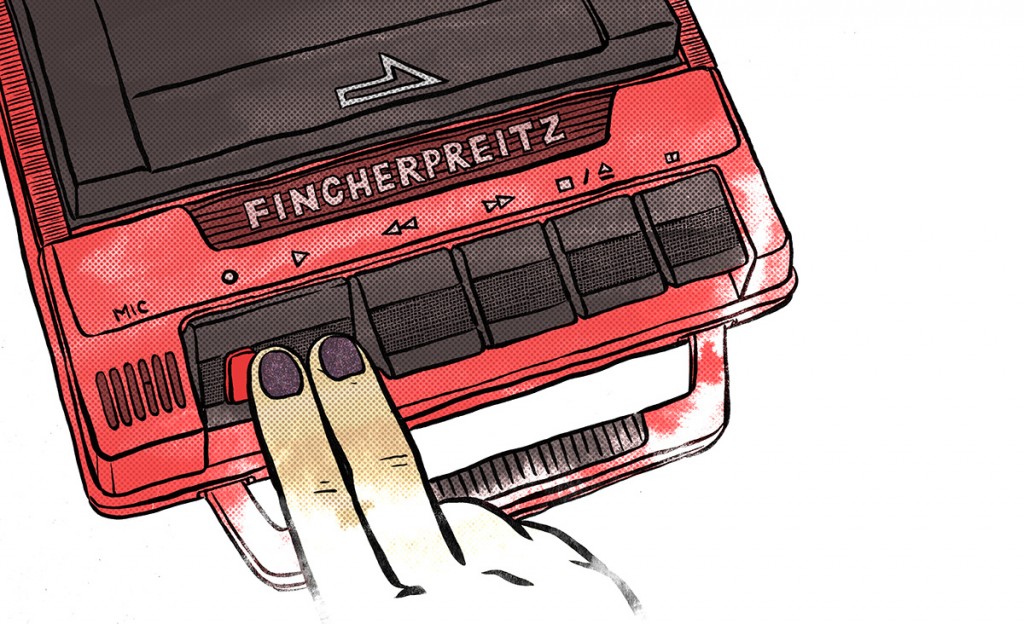
From the first season’s “Hard Day’s Pete,” the show acknowledged that kids as young as Little Pete had access to VH1, MTV—or at best, Casey Kasem’s Top 40. They could begin their own soundtracks. In the episode, as Big Pete details his younger brother’s quest for that one song to explain himself, he tells the same story of anyone who ever waited up with fingers poised above the “record” and “play” buttons on their boom boxes during a radio show just to catch their song on tape. Little Pete took it one ludicrous step further, starting a band with his math teacher, the meter-reader, and a chubby neighbor kid. (If this isn’t the archetypal makeup of most garage bands, I don’t know what is.)
While my older siblings were sneaking R.E.M., Nirvana, and Pearl Jam tapes into the house and growing their middle-parted hair long, I didn’t know that they were part of a generation that was mourning itself before it had ever grown up. Kurt Cobain looked like my brother and Alanis Morissette could have been my sister. Those voices, considered contraband in my house, cued me in to the self-awareness of the decade that would have otherwise remained inaccessible, at least until I reached middle school. Even as a grade schooler, I wanted my part in the music. I still remember sitting in the back of my mom’s ’86 Chevy Suburban, scrawling out my best guess of the lyrics to “One” by U2 with my glittery blue crayon. I didn’t get it right, and when my older sister giggled at the botched job, I was mortified because the song felt as profound as it could be to me then.
As an adult, I notice all the show’s impressive cameos of Michael Stipe, Steve Buscemi, Juliana Hatfield, and Iggy Pop. I have put together that the lead singer of one of my favorite shoegaze bands provided the vocals for a piece of the soundtrack. Although I can identify all those things now 20 years removed, that’s not why I watched the show. For me, The Adventures of Pete & Pete predated my understanding of “cool.”
 Other shows tried similar approaches, yet failed to capture my interest for long. Clarissa Explains It All, another Nickelodeon show running concurrently with Pete & Pete and geared toward a similar age group, showed a young Melissa Joan Heart addressing the audience directly—kind of like how Big Pete did; however, I could never relate to her. Clarissa was bratty, thin, and usually in her room. I liked to play outside. I felt even more distant from NBC’s Blossom, as some of the themes were a bit too old for me at the time. Both shows were particularly targeting young females who were trying to figure out their lives through their trials, spanning training bras, teen pregnancy, divorced parents, drug addictions, and pimples, and I wasn’t interested in dealing with any of those things just yet.
It wasn’t that Pete & Pete never broached any difficult subjects, but the show never had to venture into afterschool special territory in order to address the heavier side of growing up. Oftentimes, the show traded shock value for a dark, subtle comedy. Thinking of the episode “Space, Geeks, and Johnny Unitas,” I am reminded of the loner kid, Joe Jones, who Ellen and Big Pete discovered to be an alien. With the shooting at Columbine High School less than five years away, the makers of the show were demonstrating how to deal with the young outcasts around us, without ever erasing any of the elements of the absurd.
Despite his ludicrous Alfalfa hairdo and seemingly otherworldly knowledge of space travel, Joe Jones exists in every junior high school. I remember one such person as early as kindergarten. He had a terrible time because no one could pronounce his last name, which sounded close enough to “butterball” that everyone called him that. He peed his pants and stole his mother’s wedding ring for Show and Tell. Once, when charged with awakening the class from nap time and calling everyone to their snacks, I forgot to “feather dust” him, and he was finally found sobbing under a bean bag after the class had been snacking for several minutes. I think he forgave me because he taught me how to get the most out of your cupcakes by chewing on the wrapper some time that year.
Reflecting on memories like that prompts me to think that perhaps Pete & Pete may not have been so fantastical after all.
 By the third season, the show matured enough to keep up with its audience. In “The Big Quiet,” Big Pete faced the awkwardness settling into his adolescent relationship with his dad while Little Pete parted with his best friend, his pet lizard Gary. Though still ridiculous, the show captured losses of innocence that are often seen as too insignificant or normal to spend time thinking about.
Growing up, I was lucky to have a few like-minded souls around me who noticed those distressing moments. For years, I used to carry a pewter pig paperweight about the size of a Monopoly game piece in my pocket so that I could just reach in and touch it whenever I needed some courage. (Some kids have blankets; I had Rose the Pig). When I lost her during a trick-or-treat outing, my mother encouraged me to post the hand-drawn “Missing” fliers I was too embarrassed to distribute. My best friend—the one in whose house I often caught episodes of Pete & Pete—later found a duplicate of the little figurine on eBay and bought it for me for Christmas when I was 22 and still struggling months after a terrible breakup. It may be the best gift I’ve ever received.
No one ever had to tell me that life is strange or hard. As a child, I took note of all kinds of things. I just never knew that I might be able to say something about it. When I started to journal in 1994, I wrote about getting grounded for destroying the myth of the Easter Bunny for my little brother, my love for various boys named Jon, and wrote protest fiction defending the existence of dandelions in our yard. Maybe I’m being a bit of a Kevin Arnold about this, but when I revisit the show, I wonder if it influenced me or if it simply expressed something already there.
Download the entire issue here!
Jennifer Ditlevson Haglund teaches English as a foreign language in the DFW area and writes when she can. She received her MA in English from Baylor University, with a concentration in 19th Century American literature. Before moving to Texas, Haglund (nee Ditlevson) worked as a journalist in northeast Ohio. She is co-founder of the creative cooperative Present Ghost, a blog of creative writing and music at presentghost.com.
Illustration courtesy of Seth T. Hahne. Check out Seth’s graphic novel and comic review site, Good Ok Bad.