
Jul 24, 2026
by Jason Morehead
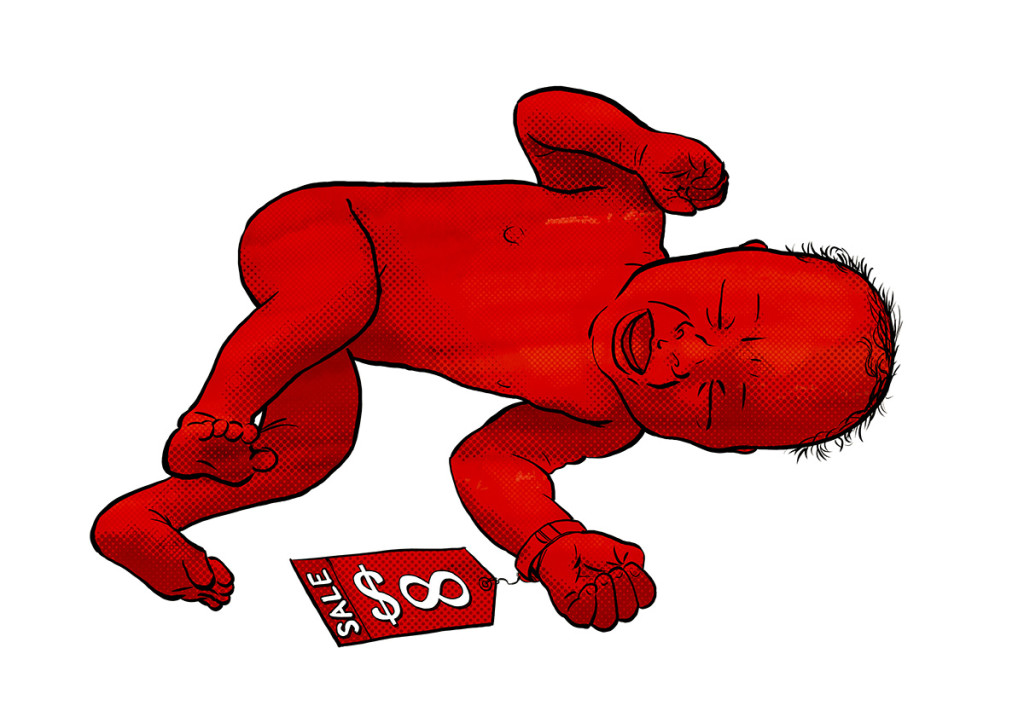
If you’ve been waiting to have children until they’re a bit more affordable, then the USDA’s “Expenditures on Children by Families” report is bound to be discouraging. According to government research, a family with an annual income between $60,640 and $105,000 can expect to spend $241,080 in food, shelter, and other expenses to raise a child born in 2012 for the next 17 years. This figure is not adjusted for inflation, nor does it include the cost of a college education — which, at the rate college educations are going these days, could easily double that amount. (In comparison, our British friends across the pond can expect to spend £150,000 — or approximately $233,000 — to raise a child for 18 years.)
Of course, that’s just the quantifiable cost. As any parent will tell you, there are many other costs associated with raising children that are much harder, if not impossible, to itemize on paper — and they’re often far more expensive.
Child-rearing costs you your privacy. Just try to avoid being overheard by the little people with whom you share your house and car. (In related news, I can’t remember the last time I was able to regularly use my bathroom in solitude.)
Another cost is relationships, which, if you’re not careful, can soon dwindle and disappear, such that you might even forget the names and faces of those who were once your closest friends. (On the bright side, if they have kids, they’ve probably forgotten about you, too.)
Kids cost you convenience and schedules, turning something as simple as scheduling dinner and a movie with your spouse into a herculean task. Personal time, including hobbies and interests, can be hard to acquire (unless you or the kids are out of the house) and is often quickly depleted.
Much of this really concerns our sense of identity, i.e., the shape we want our lives to take. For better or worse, we spend much of our pre-children (and even pre-marriage) adult years carefully constructing our lives in terms of our careers, possessions, relationships, interests, etc. That can already be troubling, since our identity should, first and foremost, be rooted in Christ, but children can quickly expose such a life for the house of cards that it is.
Children will take everything you offer them — time, energy, attention, and yes, money — and ask for twice as much with the assumption that you can — and will — give it to them right now, no questions asked. It’s so easy, pre-children, to say that you will establish boundaries, that you and your spouse will continue to make a priority those things that are important to your pre-children selves. You promise that you will still go out on regular date nights, just the two of you — and no offspring will ever change that.
My wife and I made promises like that, and now we often struggle remembering the last time the two of us enjoyed a dinner that didn’t involve macaroni and cheese or a movie that didn’t feature talking animals. (You’ll hear that children possess incredible strength and resilience, more than we give them credit for. And nowhere is this more apparent then when they’re Hulk-smashing your priorities, boundaries, and plans to pieces.)
The preceding paragraphs may seem a bit harsh, even cynical. Some readers might respond that children are their own sort of wealth, their own special kind of treasure. That the love you experience when they enter into your life and the privilege of molding a young life and seeing him or her mature and make increasing sense of the world is its own reward–a reward that exceeds any earthly treasure and is worth any material cost. And much of the time, I would agree with all of that. My wife and I have three kids, and it is indeed a Divine gift to love them, help them, teach them, and watch them mature.
When I look at child-rearing from that perspective, then, I realize that there are other costs associated with having children, costs that are also hard to quantify.
My children have cost me selfishness. I can’t count the number of times when I’ve realized that I’ve placed something trivial — like spending some quality time with my iPhone — over reading books or playing games with my sons and daughter.
My children have cost me anger. Which is not to say I never have outbursts anymore, but I’m slowly becoming all the more aware and concerned about the longterm effects my temper could have on my children.
My children have cost me complacency. Many times, when my six-year-old son is disobedient, stubborn, and full of attitude, it’s not too hard to see how much of that behavior actually originated with me and my responses.
My children have cost me my sense of pride. Sometimes this occurs in a humorous manner, such as when my child went out the front door, calling for me while wearing nothing but his birthday suit. Other times, it can be painful and embarrassing. The day I dragged my kicking and screaming child to his classroom, his boots covering my clothes in mud, and left while he was being physically restrained by the teacher and the principal, I had to eat a particularly large slice of humble pie. (My belief in my parenting competency took another hit later that day when I discovered his tantrum could’ve been avoided if I’d just taken 10 seconds to look in his backpack.)
Finally, my children have cost me some of my previous understandings of God. It is one thing to talk about God as your Heavenly Father. It is quite another to talk about Him as your Heavenly Father when you yourself are a father. (I’m writing this from a male perspective, but I have no doubt that maternal parallels can be drawn here, as well.)
Suddenly, passages like Matthew 7:9-11 and Romans 8:15 acquire an additional layer or two of meaning when considered in the light of your relationship with your own children. (And don’t get me started on Ephesians 6:4 and Colossians 3:21, which are now two of the Bible’s more dreadful verses for me.) Reflecting on the myriad ways in which you screw up your fatherhood provides for many a moment to consider and be thankful for God’s perfect fatherhood and His grace and forgiveness.
As with any cost, these are not always easy to swallow. Sin runs deeper than deep, after all. There are times — when bedtime isn’t going according to plan, for example — when I want to hold onto my pride and my anger. When I want my will done in my household, damn it, and that’s all that matters. When I don’t care that my children see my fuming and huffing and raging, so long as it puts the fear of me into them so that they’ll do what I say when I say it, no questions asked.
There are times when the introvert in me likes — even needs (or so I tell myself) — that quiet time with my iPhone. When I need to leave behind the yelling, screaming, and fighting. To let my kids fend for themselves, rather than be a force — indeed, the force — for kindness, mercy, and patience in my household. I want to be selfish, I want to be about me, if only for 15 minutes, because after all, the rest of the time I’m all about them. (Again, this is what I tell myself.)
Times like these are when I realize that my children need to cost me control. Which is not to say that I ought to abdicate my role as a primary authority and disciplinarian in their lives, or as one of their most foundational role models. But one of the principle sins that we struggle with is our desire for control and autonomy; we will do much within our power to ensure that our lives remain as unruffled by others as possible. We do everything we can to manage how others affect our lives. In their immaturity and recklessness, children completely shatter such pretenses. Which is as it should be.
Which is why I need to realize that now, more than ever, my life is not about me. It never really was, but children drive that point home like nothing I’ve known. And not only do I need to cede my control, or my desire for control, but I need to turn it over to the One Who is truly in control. Again, this is not to say that I’m just throwing my hands up and admitting defeat. Well, actually . . . it is, in a way. My life is already too big for me too handle. How much moreso the three little lives now entrusted to my care?
Jason Morehead (Associate Editor) lives in the lovely state of Nebraska with his wife, three children, zero pets, and a large collection of CDs, DVDs, books, and video games. He’s a fan of Arcade Fire and Arvo Pärt, Jackie Chan and Andrei Tarkovsky, “Doctor Who” and “Community,” and C.S. Lewis and Haruki Murakami. He’s also a web development geek, which pays the bills — and buys new music and movies.