Jul 24, 2026
The Christ and Pop Culture 25 of 2016: #5 to #1

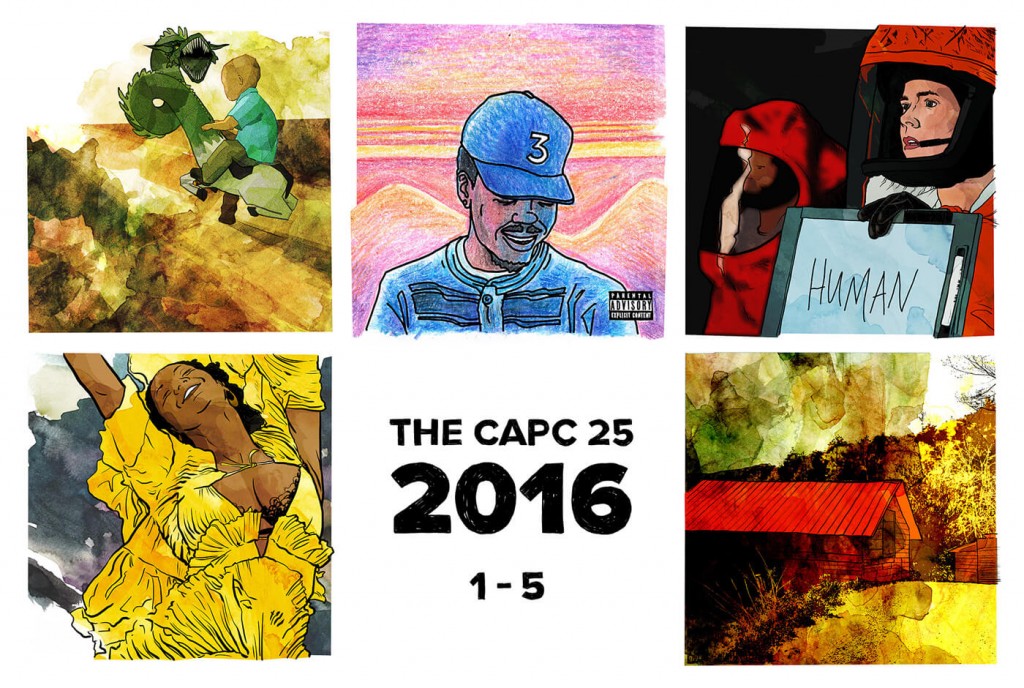
What were the most-meaningful cultural influences of 2016? The Christ and Pop Culture 25 is a list of our favorite people, works of art, or cultural artifacts from the past year that we feel best represent God’s truth and grace in the world. The list is extremely weird, a meandering, whiplash-inducing product of the diverse perspectives of our writers. We wouldn’t have it any other way. The goal of our list is to illuminate and appreciate the good both in and outside of the church, to show the way God uses Christians to shine a light on the world and the ways God’s common grace spills out into the most surprising places. We’re counting down the list each day this week; stop back to see The 25 of 2016 take shape.
Throughout the year, our podcast The 25 provided a place for Christ and Pop Culture writers and friends to nominate powerful cultural artifacts and happenings from 2016. Nominations covered a wide array of potentials from film, television, music, games, Internet, and people. We then used our magic algorithm to compile those choices into a tentative list of around 30 items. Finally, a panel of six (aka, the CAPC 25 Council), each representing various perspectives and expertise, met over the Internet for three-plus hours to hash out exactly how the list should look.
While our list is in no way meant to be authoritative or objective, it is a serious attempt at appreciating culture, a task that is at the forefront of Christ and Pop Culture’s purpose.
Our final deliberations were recorded and produced into a two-part podcast in which you can hear exactly how the CAPC 25 Council determined the order and make-up of the 25 of 2016. Part one and Part two are available to listen to.
More Installments: #25-#21, #20-#16, #15-#11, #10-#6, The 25 of 2016

Hillbilly Elegy by J. D. Vance
“[A] gateway to a larger, more nuanced discussion, the beginning of an essential conversation.”
This June, the memoir of a near high school dropout turned principle at a Silicon Valley investment firm landed on bookshelves across the country. In Hillbilly Elegy: A Memoir of a Family and Culture in Crisis, first-time author J. D. Vance chronicles his childhood among America’s white working class, offering nearly unbelievable stories of addiction, poverty, and family dysfunction while attempting to extend dignity to a people regularly lampooned by the entertainment industry and dismissed by the mainstream media. As 2016 closed, Elegy had spent 22 weeks as a New York Times Best Seller and consistently ranked in the top five books sold on Amazon.
Stylistically, the book is a mix of millennial memoir (with the requisite dash of outlier status) and sociological commentary. Even so, its success has less to do with being the right book than with it being the right book at the right time. Many readers have reached for it out of a need to understand how Donald Trump won the 2016 Presidential election, in large part by courting the white working class.
For all its success, Hillbilly Elegy has also earned criticism — everything from Vance’s political conservatism to his use of the term hillbilly (the book is actually more about the values and experiences of Rust Belt whites than rural Appalachian whites) to the temptation to derive too much from one person’s experience of the world. As with any memoir, Hillbilly Elegy is best read as a gateway to a larger, more nuanced discussion, the beginning of an essential conversation rather than the end of it. — Hannah Anderson

Lemonade by Beyonce
“Forgiveness combined with a refusal to let the men we love act as gods in our lives.”
Twenty-sixteen’s greatest argument against idolatry and in favor of forgiveness came in the form of a visual album from Beyonce, released without warning in April. Combining songs from the album with poetry by Warsan Shire and gorgeously shot visuals, the hour-long film tells a story of a woman who becomes aware that her husband is cheating. As she works through the stages of anger and grief, she realizes that the root of the problem is idolatry: her husband has a “god-complex” (“Don’t Hurt Yourself”), and she’s indulged it. Not only that, but women have allowed men to play God in their lives for generations. Beyonce reads from Shire’s poem “Mother”: “Did he convince you he was a god?” she asks. “Did you get on your knees, daily? / Do his eyes close like doors? / Are you a slave to the back of his head? / Am I talking about your husband or your father?”
Later, the words “GOD IS GOD AND I AM NOT” flash on the screen. The narrative moves away from anger and toward forgiveness. As Beyonce and a group of women in white walk into the water, she says, “Baptize me. Now the reconciliation is possible. If we’re going to heal, let it be glorious.”
Forgiveness combined with a refusal to let the men we love act as gods in our lives is the ancient, glorious way forward Beyonce makes beautifully new for viewers in Lemonade. — Amy Peterson

Arrival
“[O]ne of those rare sci-fi masterpieces.”
Technically, Arrival is an alien invasion movie. Mysterious, impregnable spaceships appear around the globe, throwing society into a panic while governments, soldiers, and scientists scramble to determine the threat. But Independence Day: Resurgence this is most certainly not. Denis Villeneuve’s masterful sci-fi film is much more than the above description suggests.
Arrival is, first and foremost, a movie about communication. How do we communicate with forces existing far beyond our normal sphere? And if we can establish communication, will it save us or damn us? What is the cost of true comprehension? What’s more, Arrival also weaves together questions about the nature of time and the value of life, even life marred by terrible sickness and death.
It makes for a heady viewing, but as Arrival enters its final, twist-filled act, and its pieces begin fitting together, the film transforms into a deeply emotional experience before ending on a devastating and bittersweet, yet hopeful note. In the end, Arrival is one of those rare sci-fi masterpieces that, like Blade Runner and 2001, will still seem ahead of its time even half-a-century from now because its focus is on deeply human questions and ideas rather than explosions and special effects. — Jason Morehead

Coloring Book by Chance the Rapper
“[M]usic should be good and the Kingdom of God is breaking into the world.”
Before the release of his third mixtape, Coloring Book, Chance the Rapper performed the song “Blessings” on the Tonight Show. Flanked by horns and backed by a gospel choir, Chance gave us the first taste of his new project: I don’t make songs for free/I make ’em for freedom./Don’t believe in kings/Believe in the Kingdom.
These lines are a mantra for the mixtape, spilling over every track. Coloring Book sometimes steps outside typical lines in regard to piety, but the lyrical and musical meanderings all find their way back to this guiding theme: music should be good and the Kingdom of God is breaking into the world. Not cordoned off for only the righteous, God’s blessing is for all people in all places.
Chance is quick to remind us, though, that the blessings of the Kingdom are different than material comfort and happiness. When, for love’s sake, we embrace our responsibility to the world, complexity and sorrow are inevitable, but even these are blessings in Chance’s economy. As the last track on Coloring Book fades, Chance, choosing to embrace the responsibilities of love, challenges us with a smile and a wink, “Are you ready for your blessing?” — Andrew Whitworth

That Dragon, Cancer
“[S]uffering is a natural and tragic part of being human.”
I played through That Dragon, Cancer (TDC) for the first time last January. The game is a remarkable experience, as developers Ryan and Amy Green, who lost their son Joel to cancer at just three years old, adapted their family’s journey into a minimalist and meditative video game. While such a decision might seem misguided, TDC is a soul-searching and elegiac experience that unabashedly points to the power of grace amidst pain and suffering.
If you’re a parent, playing this game is a testament to how much love and sacrifice exists in us for our children, as well as the crushing existential crisis that would accompany losing them. Even so, the game isn’t designed for just parents: Ryan and Amy’s story is full of beauty despite tragedy, and they intentionally constructed the game’s narrative to connect us to the countless souls who have experienced cancer’s inhumane grasp. At its highest points, the game doesn’t shy away from a harsh truth: suffering is a natural and tragic part of being human.
Yet by the end of TDC, I understood that suffering in a clearer and more beautiful way, seeing the image of God amidst the brokenness of sin’s effect in the world and within a family’s story. Ryan and Amy, in the midst of their suffering and against all common sense, embraced grace. The end result is one of the most honest and impactful games ever created, one that resonated deeper with me than anything else this year. — Nathaniel Valle
Illustrations courtesy of Seth T. Hahne. Check out his graphic novel and comic review site, Good Ok Bad.

Editor Picks
Recent Columns


Recent Podcasts

Jan 31, 2024
The Scandal of Reading 37 | Tiffany Kriner on Louise Erdrich’s LaRose

Jan 24, 2024
The Scandal of Reading 36 | Winn Collier on Wendell Berry’s Jayber Crow

Jan 10, 2024
The Scandal of Reading 35 | Lit Pulpit – The Moviegoer by Walker Percy

Dec 13, 2023
The Scandal of Reading 34 | Daniel Nayeri on Calvin and Hobbes by Bill Watterson

Dec 6, 2023