
Jul 24, 2026
The Scapegoat of ‘24’: Jack Bauer Bears the Sins of the Community

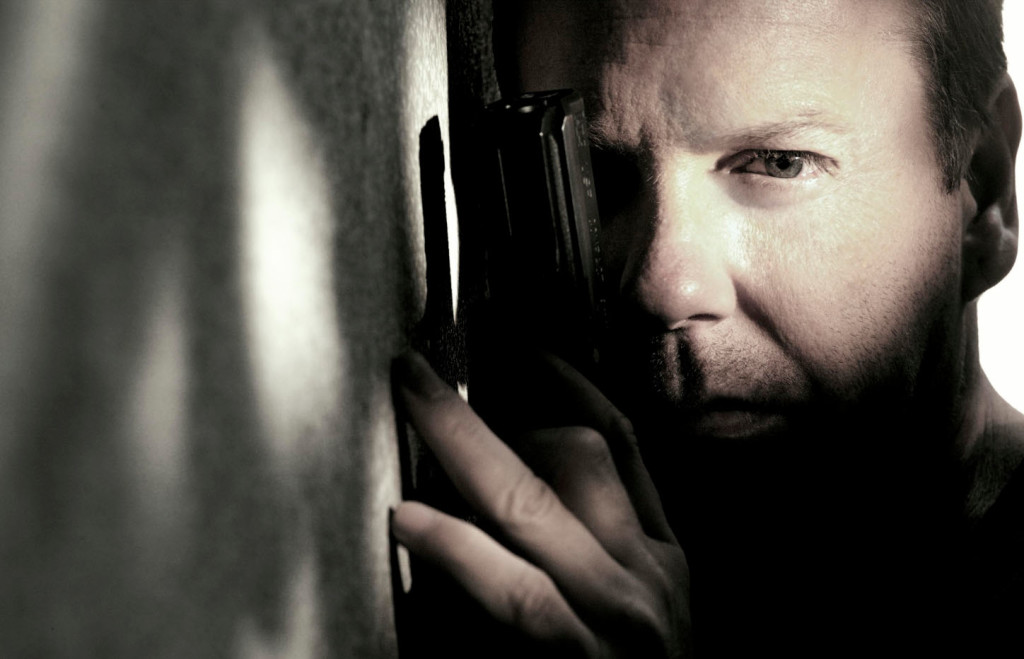
On May 5, Fox will premiere 24: Live Another Day, a continuation of its acclaimed eight-season series 24. An innovative action drama when it first aired in 2001, 24 starred Kiefer Sutherland as Jack Bauer, an agent from the fictional Counter-Terrorism Unit (CTU) tasked with addressing potential national security risks. But rather than a traditional action format, 24 was plotted to approximate real-time action, a one-hour episode representing one hour, with a full season making up one (hectic) day in Bauer’s life. A further innovation came in the show’s use of split-screens to demonstrate action that was occurring simultaneously in multiple locations.
Though first pitched early in 2001, the series may have inadvertently benefitted from airing shortly after the 9-11 attacks; in the age of America’s “War on Terror” following the World Trade Center bombings, an intense, well-designed show about the subject of national defense seemed highly relevant. In some ways, 24’s politics tracked with American popular opinion across the years. Creator Joel Surnow is a well-known conservative, and the early seasons of 24 follow a consistently hawkish Neoconservative arc. From the fifth to the sixth season, around the time President Bush’s popular was waning, a shift is detectable; even as the series’ violence became gaudier and edgier, 24 also started to question some of the methods of defense with greater scrutiny than the first four seasons. The use of torture and the detaining of suspects became more prominent aspects, and the very types of politicians and agents whose actions may have been regarded as heroic in the early seasons got crueler and more villainous. Whatever the ethnic or national background of a given season’s villains, 24 ended almost every season with some powerful white man in control; yet only in the final seasons were those string-pullers developed and explored, often in ways that could be seen as undermining the American government’s moral high ground. As such a synopsis may suggest, 24 raised many complex ethical issues related to conflicts of the twenty-first century, even if its (partial) resolutions to these issues may make the Christian viewer uncomfortable.
Apart from the narrative format — the frenetic camera cuts, the ruthlessly ticking clock — the one adhesive holding 24 together is its long-suffering protagonist, Sutherland’s intense, breathy Jack Bauer. And one needn’t watch all eight seasons of the show to see a pattern emerge, one that looks to be repeated in the latest iteration: at some point, Jack is almost always mistrusted, imprisoned, hunted, or disavowed by the very government he serves. Indeed, the degree to which 24’s producers inflict physical, emotional, and psychosocial pain on Bauer borders on sadistic, and for a time I was so exasperated that I almost gave up on the show. But I realize now that there is something of a method behind this abuse. Ultimately, Jack Bauer becomes a scapegoat, in a deeply symbolic way; he is a sort of Neocon Christ figure, a hero who vicariously takes on the sins and suffering of the American people to save them.
The post-9-11 world that 24 inhabited brought increased attention to the sacrifices made by those protecting American interests. But these sacrifices included not only personal suffering but ideological compromises. The writers of the show consistently place Jack Bauer at the epicenter of an ethical quandary lying at the heart of all governments that claim the moral high ground: what to do when the survival of the state (or at least some of the state’s innocent citizens) appears to demand the use of means that would be considered unethical in traditional “Just War” defenses. This conflict is hardly a new development; Christian rulers — who sought to administer justice in their realms while contending with adversaries who were sometimes themselves Christian — have wrestled with such matters often. In the sixteenth century, Niccolò Machiavelli’s infamous work The Prince advanced the realpolitik philosophy that rulers ought to work in the best overarching interests of the state, while being prepared to disregard moral qualms over individual decisions, even actions that others might consider cruel.
In Machiavelli’s treatise, it is the ruler, or “prince,” who risks incurring the negative judgments of others on behalf of the state at large. But in 24, the locus of that stigma is transferred to the operatives carrying out the missions, none more so than Jack Bauer himself. In Leviticus 16, God explains to the Hebrew people the ceremonial workings of the Day of Atonement, including the second of two goats, now generally referred to as the scapegoat:
And when he has made an end of atoning for the Holy Place and the tent of meeting and the altar, he shall present the live goat. And Aaron shall lay both his hands on the head of the live goat, and confess over it all the iniquities of the people of Israel, and all their transgressions, all their sins. And he shall put them on the head of the goat and send it away into the wilderness by the hand of a man who is in readiness. The goat shall bear all their iniquities on itself to a remote area, and he shall let the goat go free in the wilderness. (verses 20-22)
What better description for Bauer’s role than this? Season after season, he takes the nation’s iniquities upon himself, doing the dirty work no one wants to acknowledge. And season after season, he is ostracized from the community he has protected, formally rejected and cast out by the men and women whom he was serving. It is singularly appropriate that the original run of 24 ended with Bauer’s exile from the nation he fought for, sending him overseas into the proverbial wilderness.
Of course, in New Testament soteriology, Jesus Christ becomes the ultimate scapegoat, the one on whom all iniquity is laid. By these parallels, Bauer can be understood Christologically. Yet this Christology is one that should make us more than a little uncomfortable. Most obviously, the scapegoat and Christ both represented innocent victims (2 Corinthians 5:21) who suffered vicariously, retaining their purity in the midst of the atonement process (Hebrews 9:13-14); Bauer, on the other hand, bears the community’s sins by committing them himself. His actions allow ordinary American citizens and their elected officials to live ordinary lives and hold traditional moral or ethical standards, while he fights their enemies on their enemies’ amoral terms. The frequent implication (especially in the show’s early seasons, but really through its entire run) is the very Machiavellian perspective that no state can survive the brutal world of international warfare while retaining an intact “Just War” ethic. The survival of the state and the majority of its citizens represents the preeminent good, the end that justifies some means of dubious morality.
These considerations do not mean that 24 should be summarily dismissed. On the contrary, the issues it raises, if troubling, are also starkly important, and they remind us that we must be wary of too quickly mounting our moral high horses when discussing ethics of warfare. It is one thing to assert we will die for our principles, another thing to make that same claim when our families’ lives are at stake, and yet another thing when hundreds or thousands of lives hang in the balance. The disturbing spectre 24 conjures is that our very freedom to condemn Jack Bauer’s actions may only exist because of scapegoats like Jack Bauer.
I do not intend to condone the possible ethical lapses inherent in 24. The recent Sarah Palin debacle has demonstrated just how desensitized conservative American Christians have become to moral concerns in their relationship to national security. It is worth noting that the series is fictional and that its creators quite intentionally create such morally ambiguous situations for dramatic purposes. Robert Cochran, one of the show’s co-creators, has in the past acknowledged, “Most terrorism experts will tell you that the ‘ticking time bomb’ situation never occurs in real life, or very rarely. But on our show it happens every week.” If many shows allow their moral dilemmas to be resolved a little too tidily in the end, 24 is frequently the opposite, a little too tidy in its untidiness. In the Joseph Fletcher world of the show, situations are often carefully engineered to ensure that no truly moral option is available to Bauer or his fellow agents and their superiors. That does not obviate, however, the very real truth that we live in a sin-stained world that is soaked in evil and in which moral purity is far more radically difficult to achieve than we often want to admit. We ordinary citizens often have a hard time choosing the ethical course of action even in daily interactions; confronted with the need to make quick, real-time decisions whose outcomes could affect lives, acting justly becomes even more difficult. So if Jack Bauer’s sins make us uncomfortable, they also remind us that we must look in the mirror daily and ask ourselves how far we are willing to go for the sake of righteousness.

Editor Picks




Recent Columns


Recent Podcasts

Jan 31, 2024
The Scandal of Reading 37 | Tiffany Kriner on Louise Erdrich’s LaRose

Jan 24, 2024
The Scandal of Reading 36 | Winn Collier on Wendell Berry’s Jayber Crow

Jan 10, 2024
The Scandal of Reading 35 | Lit Pulpit – The Moviegoer by Walker Percy

Dec 13, 2023
The Scandal of Reading 34 | Daniel Nayeri on Calvin and Hobbes by Bill Watterson

Dec 6, 2023
1 Comment
While Christ was, indeed, sinless, I think that we underestimate the weight of the sin that He *became* (not simply bore) for us by implying that the gap between His sacrifice and Bauer’s actual commission of sins is as significant as you imply.
Also, I’ve never heard “neocon” used with any less derision than the other “n” word. It doesn’t really seem to fit the feel of the rest of the article.
Comments are now closed for this article.