
Jul 24, 2026
‘Where We Started’ Is a Picture of What Christian Cinema Could Be

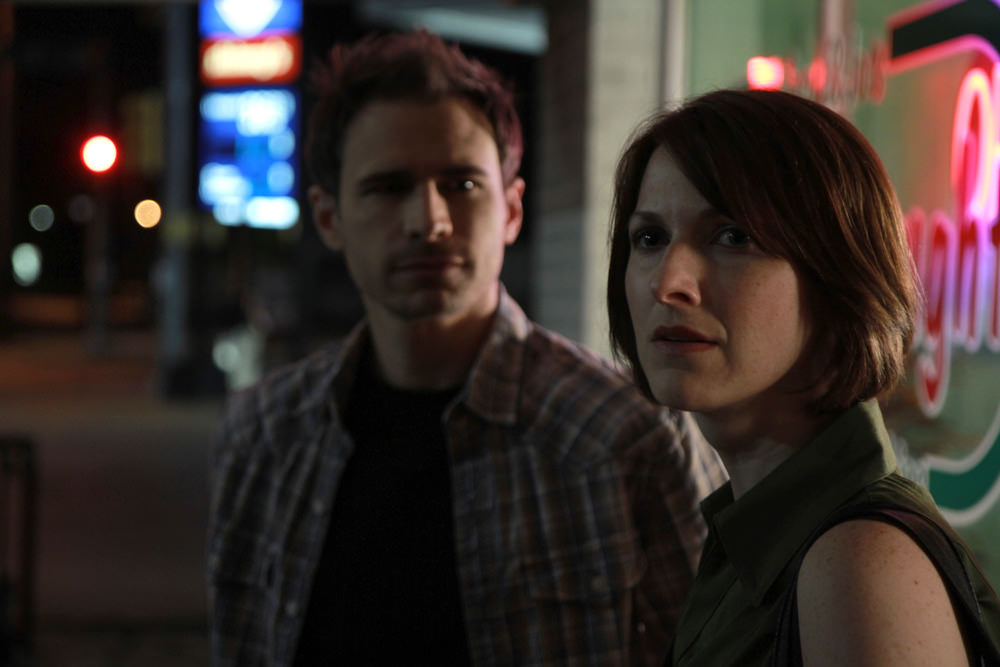
Exhausted from the road, a failed actor checks into a cheap motel. He calls his wife to tell her he won’t be in, and, unsurprised by her indifference, hangs up and lies down on the lumpy mattress. He’d sleep, but the light pouring in the window is keeping him up. So he steps outside, and just past his door is a beautiful woman smoking a cigarette. Where We Started offers a reminder of how prosaic sin frequently is: it’s neither murderous villainy nor forbidden secret pleasures, but simply broken people breaking themselves a little further.
She seems just as lonely as he is.
A banal moment, maybe. One predictable in its consequences, and maybe not one for the “family friendly” set, but it’s human. It feels real, and it’s a reminder that temptation waits for all of us, even those of us who see ourselves as “good people.”
It’s also the beginning of Where We Started, a simple indie film produced in part by the Christian school Baylor University — and one that got me to thinking about what it means to make a “Christian movie.” Where We Started is a quiet film with only two named characters that takes place in the space of less than 12 hours, and nothing explicitly “Christian” is ever mentioned — and yet, by the end, I found myself shedding real tears for the tragic weight of sin.
The film follows its two characters — wannabe actor Will (Matthew Brumlow) and bored housewife Nora (Cora Vander Broek) — from the parking lot to a diner and back to their rooms as they wrestle with what they both know they want to do and try to ignore the act’s inevitable consequences. Along the way they discuss their failing marriages, their unfortunate careers, and (mostly) John Hughes movies.
It’s not a film anyone would mistake for ambitious, but what it does it does well: it allows the viewer to step inside the two characters’ minds for a couple of hours and understand why they yearn so desperately for a moment of human connection. It leads the viewer to yearn for the climactic moment of adultery while simultaneously dreading its coming — and in that small but fundamental sense, it can be considered a success.
It’s also a picture of what Christian cinema could be, if only Christians had a bit more imagination.
As I was watching Where We Started, my mind kept returning to this piece, which appeared on ChristianCinema.com back in October, curiously unsigned but attributed to someone who worked on Left Behind (emphasis mine):
[I]t’s ridiculous to call out the production and story quality of [Left Behind]. Every single disaster movie ever made has mediocre character development, contrived plot lines that enable people to escape death…, cases of bad acting and weak dialogue…, and a combination of both quality and mediocre (or even poor) CGI. Left Behind is absolutely true to its genre, and it’s the closest we’ve come to duplicating a successful Hollywood film model.
At the time I read this, I was struck by the two assumptions at the core of the piece: (1) that a “Christian film industry” ought to exist, and (2) that it ought to look like Hollywood. These two assumptions are so foundational to the piece’s argument that I wonder if the author was even aware of them. But they are assumptions. Does there need to be a whole separate category of “Christian” movies? (And to what end? Evangelism? Preaching to the choir? Emptying the pockets of the faithful?) And if there is one, why should we expect its movies to look like Hollywood’s?
After all, there are examples of great cinema from around the world and throughout history, many of which bear no resemblance to big-budget Hollywood movies at all. (What about the German expressionism of the 1920s? The Japanese samurai movies of the 1950s? The American indie films of the 1990s?) Drawing from the limited palette of “whatever’s popular right now” is at least part of what’s wrong with Christian cinema: we’re aping tricks without understanding them, like a teenager who thinks he’s ready to start a band after learning four power chords.
Where We Started, for its part, is at times almost laughably amateurish, but because it never presents itself as anything other than a quirky indie drama, these flaws tend to be endearing instead of distracting. The viewer wants it to succeed because it’s scrappy, as opposed to rooting against it because of its hubris. And because it arrives at its conclusion honestly — letting the characters guide the action, as opposed to putting them on a predetermined track toward an obligatory conversion scene — I think it will win most viewers over, Christian or not.
Let me briefly touch on one of its flaws, though, because this one did come close to being a deal-breaker for me early on, and I think it’s instructive on the subject of how not to tell a story.
I’m referring to the aforementioned John Hughes motif. The film’s two characters keep bringing up his ’80s teen movies throughout the night, as an illustration of the central theme that pop culture gives people unrealistic expectations for love and relationships. This is fine as a theme, but the film simply ignores the rather glaring fact that its characters would both have been in diapers when Hughes films were lighting up marquees. Compounding this is the film’s occasionally stilted dialog, and in fact, Nora first brings up Hughes for no apparent reason at all, in what might be the most awkward line ever written: “Yeah, When Harry Met Sally — pretty good movie — but y’know who still gets me? John Hughes.”
This might seem like a small thing — and it is — but I bring it up as an example of how all the sincerity in the world will only get you so far if you don’t have the basics of storytelling down. It’s frustrating in part because it could have been dealt with through just a couple of lines (maybe the characters both had siblings who were ten years older and introduced them to Ferris Bueller et al?), but instead the film just expects the viewer to accept it. It’s a small thing to suspend disbelief over, but it’s annoying that we have to suspend our disbelief at all.
This sort of hiccup is frustrating because it is small (and therefore easily dealt with). It distances the characters at a point in the story when it’s crucial that the viewer become ingratiated to them. After all, the ultimate moral value of a drama like this is empathy — allowing the viewer to appreciate the universal and very human longings that lead to sin. A story about two horrible people having an affair is just a boring one, but if those characters are made sympathetic, the story becomes compelling.
Occasional hiccup aside, Where We Started actually does this very well. Once I put the John Hughes issue out of my mind, I found myself swept up in the story and the characters, yearning for them to be together but knowing they never could. In fact, it was ultimately the film’s ending that won me over. I’ll avoid spoilers, but the plot is resolved neither with divine condemnation nor idyllic wish-fulfillment, but with the simple gravity of adulthood. It’s a reminder of how prosaic sin frequently is: it’s neither murderous villainy nor forbidden secret pleasures, but simply broken people breaking themselves a little further.
This, ultimately, is the success of Where We Started. It won’t wow viewers with amazing special effects, but it does manage to find some wisdom in the mundane — which is arguably a much greater accomplishment.
Note: Where We Started is currently available for viewing on Amazon Instant Video. It’s free to Amazon Prime subscribers.

Editor Picks




Recent Columns


Recent Podcasts

Jan 31, 2024
The Scandal of Reading 37 | Tiffany Kriner on Louise Erdrich’s LaRose

Jan 24, 2024
The Scandal of Reading 36 | Winn Collier on Wendell Berry’s Jayber Crow

Jan 10, 2024
The Scandal of Reading 35 | Lit Pulpit – The Moviegoer by Walker Percy

Dec 13, 2023
The Scandal of Reading 34 | Daniel Nayeri on Calvin and Hobbes by Bill Watterson

Dec 6, 2023
14 Comments
Can I pick a possible nit?
Is there anything in the movie that states/implies that it takes place in current times? Or might it also work as being set around the turn of the century, when the Hughes references wouldn’t be quasi-anachronistic? And if so, maybe those references are specifically the subtle way that the movie tells us when it is set?
Heh. Well, no worries about the nitpicking, since I started it. :)
The answer is: in the first place, no; in the second place, why?
“No” because you see the characters using modern iPhones (which would put it half a decade too late at the absolute earliest). “Why?” because it seems a little silly to set a movie ten years ago. There’s not much of a tradition of storytellers doing that, which makes it jarring, and without an intertitle saying “2000” or something, there’s no way to know.
Again, it’s not a big deal once you get past it, but it is an unnecessary annoyance at the worst possible moment in the film’s emotional trajectory. It’s something the screenwriter should have dealt with in the revision process.
Just following on the nitpick spot as it kinda became a pet peeve reading about it,
I didn’t quite understand why the characters had to see those movies when they came out. Couldn’t it be that the characters have just seen the movies when they weren’t in theaters? I mean, that’s how I’ve come to love John Hughes and his movies all while being born in the 90’s.
But I’m just asking questions.
See, that’s what I’m saying, though. It would be fine with a line or two of explanation. Without, it’s just bad writing.
I think “a line or two of explanation” would be pandering to the lowest common intelligence denominator — like something from American network TV. And I say that, knowing fully well that I’m a naive — bordering on stupid — viewer who needs that pandering at times.
You classify a lack of explanation as “bad writing”; I’d classify the addition of explanation as ham-fisted writing.
I am reminded of an Animaniacs episode that I re-watched the other day. Skippy Squirrel gives some backstory quickly with a line or two. Slappy breaks the fourth wall and — with tongue firmly planted in cheek — says to him (over her shoulder), “Thanks for the exposition.”
All right, you win. No movie should be required to make sense. They should all just skip to the explosions. :)
Imagine how much better Citizen Kane would have been. I can hear Welles snarling, “I’ll be back, Rosebud!”
Haha. I would watch the crap out of that movie.
I understand your issue with the age of the characters and the John Hughes fandom, but for the record I do know Hughes fans that are in their early twenties. Movies like Pitch Perfect and especially Easy A have introduced younger audiences to Hughes’ genius. Plus things like netflix make it possible for them to stumble on classic movies from different eras. Just yesterday I saw an explicit reference to The Breakfast Club in the show Unbreakable. And of course the young women watching it with me knew what it was.
Don’t the characters in You’ve Got Mail constantly make references to Joni Mitchell, even though the Meg Ryan character would have been way too young to be a Mitchell fan when her records were actually coming out?
Okay, I guess she’s not supposed to be THAT young. But say she’s 32 or thereabouts in 1998. That would put her at about ages 3 to 10 when Mitchell’s glut of early albums is released.
https://thimblerigsark.wordpress.com/2014/12/04/3-reasons-why-a-christian-film-industry-is-a-really-really-bad-idea/
Thanks for the heads up on this film, Luke. I’ll be giving it a try.
Meanwhile, a couple of months ago I wrote a piece about why I believed a Christian film industry to be a terrible idea. I’d invite you to read it, and would love to hear your thoughts.
https://thimblerigsark.wordpress.com/2014/12/04/3-reasons-why-a-christian-film-industry-is-a-really-really-bad-idea/
Cheers,
Nate
Comments are now closed for this article.